October 1918 was one of the scariest months for many Americans. That year the United States, and the world, suffered the deadliest influenza pandemic in history. One fifth of the world population is thought to have contracted the 1918 influenza virus, also referred to as the Spanish Flu. In the U.S., deaths from complications of the disease were estimated at between 500,000 and 675,000, with most occurring in October 1918. Fatalities worldwide have been placed at between 30 and 50 million. With the proportion of the population that was infected, it is likely every family knew someone who had the flu, or even succumbed to it. I found some cousins who had the Spanish Flu, but the closest family member known to be infected with it was my grandfather’s brother Ira Rugh Ludwick.
The origin of the Spanish Flu is unclear; it is thought to have made its appearance earlier in either the spring of 1918 or sometime in 1917. The PBS show American Experience relates that in March 1918 an outbreak occurred in this country that lasted several weeks. Within a few weeks Fort Riley KS, reported 500 cases of an illness that resulted in pneumonia and the deaths of 48 soldiers before it disappeared as quickly as it came. There were other cases reported around the world that could have been the early strain of this virus. Since Spain openly reported its flu numbers and deaths in the early part of 1918, the outbreak was dubbed the Spanish Flu.
On August 11, 1918 The Pittsburgh Press in an article headlined “Spanish ‘Flu’ Spreads All Over Europe” reports how the people of Britain, France, Portugal and Austria were all suffering from the flu and its effects. This article relates how even the battlefield was not safe from this affliction as two German armies were battling the flu in camps, rather than fighting the allies in the trenches. The unsanitary conditions of the front, paired with the close quarters of the soldiers, supplied a good breeding ground for disease to develop and spread. As the war raged on through the summer of 1918, influenza continued to wage its own campaign, infecting and killing soldiers on both sides.
As the United States prepared with her allies for an assault on the German lines to bring the war to an end, the government enlisted and deployed thousands of troops to replace those soldiers who were coming home from the front. But some of those returning soldiers carried the flu virus. In early September the flu reemerged on U.S. soil and spread from one army base to another. By then, however, it had mutated to an even more infectious and lethal disease. Once the first few victims contracted the flu, it quickly spread.
By the middle of September the virus had infected the civilian population. Cities like Boston and Philadelphia were hit hard. The Washington Herald in D.C. reported in its September 23, 1918 edition that “Boston [was] panic-stricken” by the flu. It continues:
“With the city depleted of doctors and nurses by the war, those remaining are staggering under the work of trying to keep the epidemic under control. People are being stricken down in the streets, offices, subway, theaters and shipyards. The hospitals are crowded to the limit, and under strict quarantine to visitors. Over 6,000 soldiers are down with the disease at Camp Devens, while civilian cases in the Boston district number at least 10,000. As many as forty-three victims have died in one night in Boston alone. Whole families have been wiped out.”
Other areas, from urban to rural settings, had similar experiences of devastation. As September passed, the flu grew to pandemic proportions, infecting thousands. No one was safe.
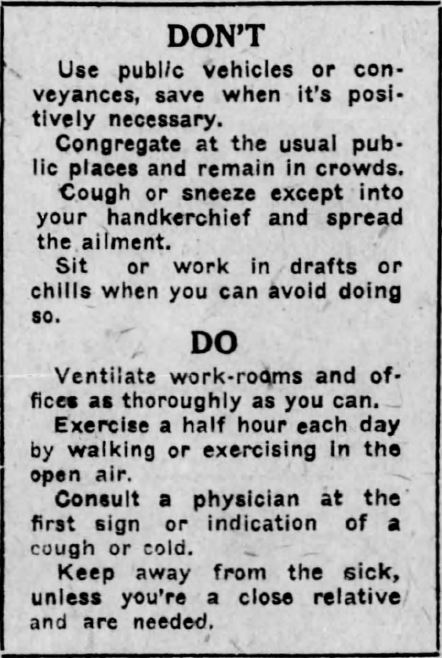
If September brought panic, October held terror. The number of cases rapidly grew with deaths over one hundred a day for larger cities. Papers reported the number of flu cases contracted in a 24 hour period; often a drastic increase of the previous day. The Buffalo Courier on October 6, 1918 ran a story with the headline “17,303 New Cases of Spanish Flu Reported in a Day” which detailed the escalating flu numbers in the army camps. Across the country, as the infection rates and death tolls rose, there was a shortage of doctors, nurses, hospital beds, coffins, and grave diggers. Public gatherings were suspended. Schools and churches were closed. People were advised to stay away from public places. Papers, like The Altoona Tribune, printed guidelines of how to stay healthy.
It was October when my grand Uncle, Ira Ludwick, the third child of Alpheus and Mary Frances Ludwick, contracted the flu. Ira lived in the small town of Youngwood, PA and worked as a flagman for the railroad, a job that probably exposed him to a variety of people from different places, and possibly the deadly flu virus. He was 34 years old, putting him in the age group at highest risk to suffer the deadly complications of the virus. Unlike other flus that killed the elderly or very young, this one favored the lives of young strong adults. On October 21 Ira had seen the doctor; five days later he died from bronchial pneumonia, one of the primary complications of the flu. Ira left behind a widow, Pearl Hank Ludwick and two small children, 7 year old Ira Paul and 5 year old Charlotte. Ira was buried in St. Clair cemetery in nearby Greensburg. Pearl and her children eventually moved back to her hometown of Altoona PA.
As November arrived the number of flu cases began to subside. Although new infections were reported over the next couple of months, the worst was over. Families were left altered by the deaths they endured. Yet for all the destruction, it has been observed that the pandemic of 1918 is not a topic in history classes, and those who lived through this harrowing time didn’t talk about it. Such seems to be the case with my family.
The Spanish Flu was not a subject that I can recall anyone in my family discussing, except to add as a footnote that Ira had died from it. The details of his illness or whether other family members were sick were not divulged to me. With the scope of the epidemic, others in my grandparents’ families most likely would have been infected by it. Either they had the flu and recovered, lived in places not widely touched by it, or escaped it altogether in the midst of the chaos. Whatever the circumstances, it was miraculous that in my family Ira was the only fatality from influenza; indeed, my four grandparents and their extended families were extremely fortunate to have survived this tragic period in American history.
 Relatively Speaking Blog