“In this world nothing can be said to be certain, except death and taxes” wrote Benjamin Franklin in 1789. So for tax month, I am including some extractions of county tax rolls from around this time period. On the surface tax lists might appear to be non-essential information that only provides what a person owned for a particular year, in a particular place. However, these documents, if they have survived, can supplement other genealogical research. In addition to verifying a relative’s residency or if he owned property, these records can offer a time frame of when a person moved into an area or left it, either by relocation to another county or that other certainty—death. Continue reading
Surnames
The Deeds of Mary Brown
Deeds are documents that show ownership of land and record the transfer of property from one party to another. In Pennsylvania, as well as other states, they are managed at the county level by the Recorder of Deeds office. Each one contains basic information, such as the names of the parties, date of the agreement, a description of the land—often including neighbors—and the amount for which the property was sold. When a land holder dies intestate—or without a will—the property transfer might be the only reference of the decedent’s death. This was the situation for my second great-grandmother, Mary Brown, in Lycoming County, PA.
Census Through the Years: Alpheus Ludwick
Alpheus Henry Ludwick, my great grandfather, lived the latter part of his life in the small town of Youngwood, PA. My mother remembered Alpheus, her grandfather, who would walk through town and shake his cane at motorist he thought were driving too fast. From her stories I picture him as a gentle and loving man, despite a number of sad life experiences.
Remembering Alvin
This January 29th marks the 110th anniversary of the birth of my Uncle Alvin, who must have inherited physical stamina and endurance. He was named Alvin Rudolph Brown, but we always called him Uncle A. Alvin was the second child and oldest son of Charles Weldie Brown and Lucy Belle Swank. He was born in Davidson Township, Sullivan County according to his birth certificate, which his father signed, indicating there was no doctor or midwife present during his delivery.
Remembering Mazzie Marreta Que
On September 19, 1918, my grandparents Charles and Lucy Brown welcomed the arrival of their sixth child, Mazzie Marreta Que. Mazzie, or Peggy as she was commonly called, was born in Ralston, Lycoming County, PA just one week after her father registered for the draft for the First World War. Fortunately the war was near its end and Charles was not selected to serve. Shortly after Peggy’s birth, Charles relocated the family to Indiana County, PA, where Peggy would spend the majority of her life. Continue reading
Census Through the Years: Henry Swank
Although the United States Census is a useful means to gather information about families, the recorded information could contain misspelled or inaccurate names, age differences—sometimes drastic—from one census to the next, misidentified gender or misattributed relationships between household members. This is one reason researchers do not take the census data as fact until other documents have been located to validate the enumerated information. Continue reading
Jessie Jobes and the Army Nurses Corps of WWI
 One hundred years ago this month Jessie Fowler Miner Jobes, my grand aunt, was among the patriotic women who entered the Army Nurses Corps (ANC) during World War I. Jessie, born February 12, 1883 to Charles and Lydia Fowler, grew up in Fayette County, PA and married Clifford Minor in 1903. As reported in the 1910 census, Jessie had no occupation, and at some point in those 7 years of marriage she had a daughter. My grandmother, Marjorie Ludwick who was a sister to Jessie, related the following story: Marjorie, their sister Addie, and their mother “went to visit Jessie and to see the new baby who was about a week old. They stayed about 2 hours and before they left they looked in on the baby again, but in that short span she had died. Clifford didn’t live long after that; he had some health issues that caused him to be bedfast.” Perhaps taking care of her ill husband prepared –even inspired—Jessie to become a nurse. Continue reading
County Histories: Westmoreland County Rughs
Around the turn of the 20th century, comprehensive histories were compiled for many of the U.S. state counties, providing background on the early events of the area, the formation of the county and its townships, and its industry, politics, and religions over the years. Mentions of prominent residents of the area, sometimes with a detailed biography were often included, but the profiles of these county citizens were more family stories, rather than documented accounts. Typically the subject’s national origin was listed, with a lineage that traced back to his first known ancestor to inhabit the county. Family members were identified often along with details about education, occupations and places the family had settled. In addition, these histories mentioned births, deaths and marriages, listing a year, and in some cases an exact date, though details would need to be verified, as the information might contain inaccuracies. Continue reading
Census Through the Years: Philip Brown
Details about the life my 2nd great grandfather, Philip Brown, are sparse. Philip, the earliest identified ancestor on my direct paternal line, appeared in North Central PA during the first half of the 1800s. For several years in the mid-1850s Phillip appeared on the tax rolls in Lycoming County PA. In addition to 2 cattle and 1 cow, he was taxed on 100 acres of land, but no recorded deeds were filed at the courthouse for his land. No other county documents have been located for Philip, leaving many questions unanswered about his life and origins. Besides these tax lists, several census enumerations for Philip are the only other resources that offer a few brief glimpses about him.
I first located Philip in the 1850 census in Franklin Township, Lycoming County, PA. According to this he was born about 1805 in Pennsylvania, the birthplace noted for all members of his household. Philip had real estate valued at $300, further emphasizing he owned land. Many land owners of that time were farmers, but Philip, surprisingly, was a laborer. Philip’s wife Mary was 42, and their household consisted of the following children: William, 20; Catharina, 16; John, 15; Isaac, 12; Elisabeth, 10; Hester, 8; Susan, 4.
Philip was last documented in the 1856 Franklin Township tax rolls, but exploring the 1860 census he was not listed. Mary was found residing in this township as the head of the household with five of their children, suggesting that Philip had died sometime between 1856 and June of 1860. No grave has been located for Philip, but it is suspected he was buried nearby in Stoneheap Cemetery.
Searching earlier census years for Philip becomes more challenging, since only heads of households were named. Using the 1850 census as a guide, Philip’s family in 1840 would have consisted of at least 1 male about 10 years of age, 1 male about 5 years of age, 1 male under 5, 1 female 5-10 years of age, and possibly a female 0-5 years old in his household. This information was useful in identifying the proper family.
The 1840 census had no Philip Brown residing in Lycoming County, but three were found in neighboring Columbia County. One in Roaring Creek Township is too old at age 70-80 years. Filip S. Brown in Briar Creek Township was between 30-40 years old—the right age—however, with only one male age 15-20 years old in his home, this disqualified him as a match. The Philip Brown household in Fishing Creek Township corresponded with the expected number and ages of his family members. With presumed names and birth years of Philip’s family members in parenthesis—the extract of the 1840 census listed: 1 male 0-5 (Isaac, 1838); 1 male 5-10 (John, 1835); 1 male 10-15 (William, 1830); 1 male 30-40 (Philip, 1805); 1 female 0-5 (Elizabeth, 1840); 1 female 5-10 (Catherine, 1834); 1 female 10-15 (Rebecca, 1832); 1 female 20-30 (Mary, 1808). Rebecca, their eldest daughter had married about 1848, which explains her absence in Philip’s house in 1850.
In the 1830 census Philip Brown was again enumerated in Fishing Creek Township with three members in the family: 1 male 0-5; 1 male 20-30; 1 female 20-30. Comparing the three enumerations, William was born about 1830 and would be the male child, probably only a few months old when the census was conducted. Philip and Mary, the two adults, most likely married around 1828, but it is uncertain if they married in Columbia County or elsewhere before they settled in that county.
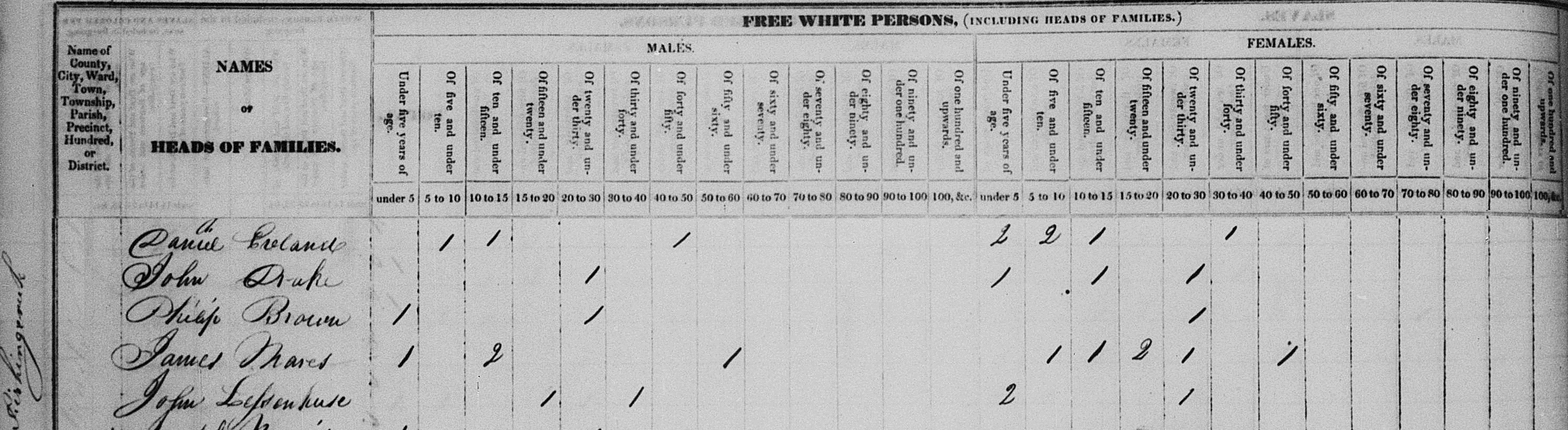
Attempts to find additional documents for Philip Brown have proven difficult. Although he lived in Fishing Creek Township in 1830, finding Philip in the 1820 census is impractical without knowledge of his father’s name and residence, since at age 15, Philip would have been enumerated as only a tick mark. In Columbia County nothing has been located to help illuminate his life or origins. In addition, the common Brown surname makes discovering potential parents for Philip an arduous task.
One hypothetical lead has been suggested by a few researchers, but it requires further investigation. In the 1820 census for Fishing Creek Township, where Philip was living ten years later, Richard Brown resided with a male child between 10-15 years of age. Philip would fit into that age category and some suspect that Richard could be a relative of Philip, perhaps even his father. While it is worth considering, no evidence can be found to prove a connection between Richard and Philip. It could be a coincidence of two men who shared a common surname and lived in the same place, but who had no relationship between them. So for now, one can only continue to search for more clues about Philip in the hopes of discovering where his origins, as well as ours, lay.
Christmas Letters
The holidays are a wonderful time for connecting with family and friends. Since the 1840s, many have sent greetings to loved ones with Christmas cards expressing sentiments of good tidings for the holiday season and happiness for the upcoming year. Sometimes in the card the sender jots a short line or two or includes a letter. In the past 25 years, with the popularity of computers, the letters have become typed and printed on festive paper, allowing the writer to produce many copies with the same content. Occasionally these form letters are sent in place of the typical greeting card. Continue reading
 Relatively Speaking Blog