My maternal grandmother Marjorie Fowler Ludwick lived to be almost 102. When I became interested in genealogy, I would try to get information from her about the family and her life. On one such occasion I asked her about her early life, which began in Fayette County, PA. Marjorie was born in 1894 in Smithfield, PA, the youngest of seven daughters of Charles W. and Eliza Fowler. Continue reading
Author: tcbrown
Ornamental Reflections
Every December the time comes to pull out the boxes from the basement and begin the mission of decorating for the holidays. For me though, trimming the tree is a journey back in time. As I pull them from their containers and unwrap them to put on the tree, many of the ornaments evoke a sentiment of past holidays. As I place each one on the tree I always take a moment to observe what recollection it brings to mind. Now that my parents are both gone these memories take on an even stronger significance. Continue reading
199 Reasons to Give Thanks…and Counting!
At this time of year, I remember my parents with gratitude for the many things they did for me. I also reflect on the generations before them and the efforts they made that have enabled me to be here today. I appreciate the stories I’ve heard about my grandparents, great grandparents, and a few generations that go a little further back. I also have gathered names of ancestor’s whose stories I am still trying to discover; and then there are the many more unfilled names on the family tree waiting to be found, which would be an unachievable task to fill them all.
When looking at a pedigree chart, it is easy to see how each preceding generation doubles the number of forebears. To trace 6 generations and locate all of one’s 4th great grandparents, that search would involve seeking 32 sets of 4th great grandparents. But first, one would have to know his parents, grandparents, as well as the 1st, 2nd and 3rd great grandparents, for an additional 62 people, or a total of 126 ancestors. If this person were about 65 years old, and a generation spanned about 30 years, many of these 4th great grandparents would have been born sometime between the French and Indian War and the start of the Revolutionary War when the population of the American colonies reached 2.2 million. Continue reading
Ludwick Lore and the Civil War
Most families have a few old stories that contribute to the chronicle of its history. These accounts, usually handed down verbally through the generations, might include an ancestor who was robbed of land or possessions, descended from a famous person in history or from royalty, or encountered great difficulty on the journey to America. The retelling of the events becomes an integral part of the heritage and tradition of the family. However, the details we know today are probably changed from the original, like in the children’s game of telephone, where a sentence is passed around a circle and invariably is altered when it reaches the last person. Most likely there is some grain of truth in the version we hear, even though it might sound more like legend or myth.
In my family there are numerous stories; however, some of them, unfortunately, have unraveled into bits and pieces in my memory. One such fragment involved a relative who was sick in bed when troops came by the house during the Civil War, an event now over 150 years ago. Where I had heard it, or what relative it included was unclear to me until about 10 years ago. Continue reading
Remembering Silveretta
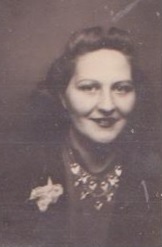
This year marks the 100th anniversary of the birth of one of my aunts, Laura Silveretta Oranna Brown, who was born in January 1915. She was the 5th child born to Charles and Lucy Swank Brown, in Aurora NY or “York State” as the family always referred to it. In 1918 the family moved to Indiana county PA where Silveretta, or Sally as she was commonly called by family, spent most of her life, except when she worked for General Electric Company as a laborer in Erie for a period of time. She never married and resided on North 11th Street in Indiana PA in the house her parents bought during the 1940s.
Maryland Mission: The Blackstone File
“I’m looking for information in a vertical file that might be here,” I explained to the librarian. We were recently in Baltimore on our way to D.C. and I was trying to find documents that would fill in some gaps for my 4th great grandfather James Blackston—also spelled Blackson, Blackstone, Blacksen, and Blackiston. Earlier last year I stumbled upon a post on Genforum.com by a distant cousin mentioning a vertical file in a Baltimore library containing something that seemed to substantiate James’ parents–although it didn’t indicate what the actual information was. I have lost touch with that cousin, and I hadn’t printed out the query. So I went back to the site before our trip only to find it had been archived by another company; searching was greatly inhibited and the particular query I needed could not be found to identify the library. A quick online search of Baltimore libraries with vertical files had 2 possible candidates, so we stopped at the first one I found, where I tried to explain, without sounding like a complete novice, my quest. Unfortunately, the vertical files there didn’t contain any Blackistons, but the librarian, from a quick card catalogue search, indicated some Blackiston material was at the Maryland Historical Society Library (MHSL), which we decided to visit on our way back home. Continue reading
Searching for Sarah
Hunting for one’s foremothers can prove challenging in the United States, where a woman usually takes her husband’s surname when she marries. If she marries more than once, she becomes further removed from her initial surname. Early records might even list her only as Mrs. Smith or Widow Smith additionally distancing her from her original identity. Then generations that follow often confuse their maternal ancestor’s birth names as evidenced by records, like death certificates, that have muddled a mother’s maiden name.
In 19th century America, a female had fewer rights than men for owning property or conducting her own business and often needed a man to assist her. When she transferred land, created a will or even administered her husband’s estate, she would often turn to someone she trusted, like a brother, cousin, son or father to aid her in the matter. Finding documents created by women, especially young women or widows, can aid us in identifying our female ancestor’s lineage, if we closely observe the names of the people mentioned and include them in our research.
Following this thinking, last spring I ventured to track my 3rd great grandmother, Sarah, for whom I had only a handful of facts. I had established the following: Continue reading
Springing Into Genealogy
I have been able to trace my ancestors who have resided in this country for over 200 years, with many living in Pennsylvania. My paternal lines settled in the early 1800s in Lycoming and surrounding counties while my maternal lines settled in southwestern Pennsylvania counties before 1800. I’m fortunate that I’ve been able to visit these counties and collect information on them and their descendants. Being a native Pennsylvanian myself, I can often name relatives who are buried in cemeteries that I pass.
When this occurs, my husband Victor will usually say how lucky I am since my ancestors could be found in a short drive. See, his grandparents arrived in America from Italy around the turn of the 20th century and only one set of his great grandparents are buried in this country. He has names that were collected from his grandparents about their families, but Victor kept hitting a brick wall when he tried to find something online to document that these names were accurate. Even ancestry.com didn’t have records that helped. He was a bit envious that is was so ‘easy’ for me.
On our 2014 trip out west last June, however, that changed. Continue reading
Welcome to Relatively Speaking Blog
For ten years, starting in 1995, I published Relatively Speaking, a family newsletter focusing on my paternal lines. One of my goals in creating the newsletter was to involve my cousins with our heritage, and provide a platform for them to share their family stories, memories and traditions that had been passed down. In addition to my aunts and uncle, some of my distant cousins were most enthused about helping with information by sending me newspaper clippings, obituaries, stories, and evidence from research they had conducted.
The newsletter was a way for me to disseminate the stories and names I had discovered researching the family. I wrote 62 issues that I distributed to a small circle of relatives and a few genealogical societies. I enjoyed putting the issues together, rediscovering documents I had stacked away and hearing back from relatives with what they had to add; but a shortage of time was a big factor in ending this venture.
Now in 2015, I’ve organized and recorded much of the research I had done years ago. My database has tripled to over 15,000 names and I have a lot more information to circulate to relatives. Since I stopped producing Relatively Speaking, technology has greatly advanced making dispersing information much easier and certainly less costly. With that in mind, I have decided to remount Relatively Speaking in blog form to continue my goal of sharing family history—both maternal and paternal, as well as an occasional collateral line—in the hopes of reaching an even wider audience.
 Relatively Speaking Blog