For a genealogist, vital records, such as marriage documents, hold great significant for research and for adding details about a relative’s life. An application for a marriage license can provide information about the couple, including ages or birth dates, occupation, and the couple’s parents, which can extend the family line back an additional generation. Until the 19th century, Pennsylvania kept no official records of marriages.
Before the state implemented its marriage license application process, churches typically provided couples with a marriage certificate signed by the officiant. Some denominations were better at keeping and preserving records. Records from colonial times and immediately following are less likely to have survived, though abstracts of some of these do exist and are available online. To find original records, one needs to contact the appropriate church to determine where their archives are kept and what might be available.
Through my research, I discovered relatives who were Quakers in the early 19th century. Ancestry.com hosts images of minutes from Quaker meetings which document instances when couples announced their intent to marry. Other Quaker files on ancestry.com, likely transcribed from the minutes, contain family groupings, including spouses and marriage dates if available. This data has expanded my family tree. However, obtaining an actual marriage certificate would provide concrete proof of the matrimony.
Genealogists have compiled marriage records into printed books, providing an additional valuable source for research. In western PA, one such dedicated researcher was Della Regan Fischer. During the 1960s and 70s, she preserved various types of records within the numerous books she compiled. While many of her books focused on gravestone readings of cemeteries in Western PA, some included church records. Notably, several books feature Brush Creek churches documenting marriages that began around 1820. For those with relatives who were members of these churches, these books are a terrific resource.

During the early 1850’s Pennsylvania instructed counties to collect registrations of births, deaths, and marriages. However, the state never enforced compliance, resulting in minimal participation at best. After a few years, the state’s effort to record these events temporarily ceased. The registrations that were filed are now available at the courthouse in the county where the event took place. When my 2nd great grandparents John and Esther Ludwick married in 1853 in Westmoreland County, they did comply. This provides additional evidence of the relationship between John and his parents Abraham and Mary.
In 1885 the state implemented new requirements for the Clerk of Orphans court in each county to issue marriage licenses before an officiant could perform a wedding. Applicants had to be 21-year-olds or have permission from a parent or legal guardian to marry. Each county had its own application, so the information gathered on the forms varies from county to county, and occasionally from one year to the next. A license from one county can be used anywhere in the state. Some counties, like Westmoreland, enabled its website to be searched and to display basic information about a couple, their marriage date, and application number for every application.
Because of this law, my 3rd great grandfather Joseph Blackston was required to obtain a license for his third marriage in 1887 in Westmoreland County. Joseph was 76 years old—although he was listed as only 70. His bride Mary Ackerman was 30 years his junior. Joseph’s marriage application is the sole document I have located that contains the names of his parents—James and Melia Blackston. Perhaps someday this information will prove beneficial in my quest to learn more about his mother, who died before Joseph reached adulthood.
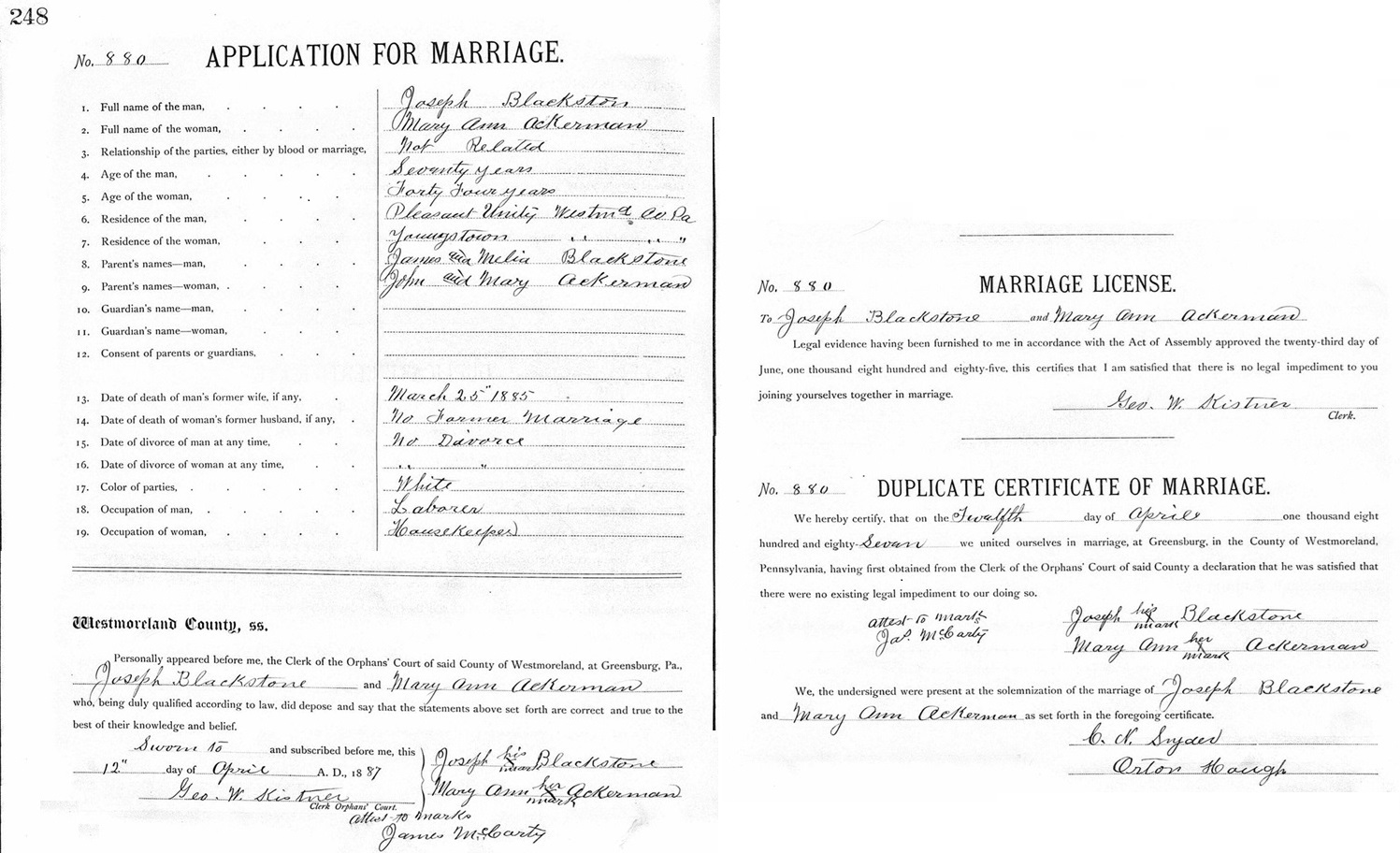
Many of the early marriage applications for Pennsylvania are available digitally on the web. During the 1940s the Latter-Day Saints went around the globe microfilming records for genealogical purposes. Each of the PA counties, except Lycoming which did not participate in the Mormon’s effort, have some of their applications available on FamilySearch. A search feature for Pennsylvania marriages makes locating an ancestor’s marriage record an easy task.
Newspapers are another source I have used for finding marriages. Fischer compiled extracts of marriages listed in old newspapers from the 1800s. These are another invaluable source that sometimes mentions the parents of the parties, date and place of marriage, and the original paper to reference the actual listing. Papers from the past 100 years or so have expanded marriage announcements. These can be a few lines to a huge spread, elaborating on the wedding and details, along with a photo of the bride.
One can visit a local library to view local newspapers on microfilm or view any of the digital online newspaper collections to look for marriage announcements. Since the implementation of marriage licenses, newspapers often list applicants who applied for a license. If a marriage application or license cannot be found online, locating a county’s listing of parties applying for a license in a newspaper can provide a timeframe for when a couple married. The key is knowing which county to investigate.
As a family historian, I know the excitement that comes from locating a relative’s vital records. When exploring marriage documents in Pennsylvania, or any locality, it’s important to understand that availability can vary from county to county, especially for older records. While the digital age has made researching more convenient, there remain instances when a visit to the county courthouse will yield the best results. Each discovered marriage record offers a unique insight into the lives of a couple and strengthens our connection to our past.
 Relatively Speaking Blog