Harry Russell Brown was an older brother to my grandfather, Charles. Because Harry died when my aunts and uncles were young, their memories of him were vague, and they had few stories to tell. Turning to the census and other documents, tiny glimpses into Harry’s life were revealed.
My grand uncle Harry was born January 1, 1877 in North Mountain, Lycoming County, PA. Some other documents list his birth year as 1876, but Harry’s parents, John and Margaret McGarvey Brown, were married in the fall of 1876, so 1877 would appear to be the more correct year. John and Margaret were both previously married with children, and Harry was the first child to this second union.
Harry was first enumerated in the 1880 census when he was still a young boy living with his parents on the Brown homestead in Franklin Township, Lycoming County, PA. His age was listed as four years old instead of the expected three, supporting the birth year of 1876. His baby brother George and older half-brothers Francis and Peter Adam were also in the household; his other half-siblings were either married or lived and worked in nearby households.
Since the 1890 census was destroyed, this leaves a gap in learning about Harry’s life. He probably attended school, at least long enough to learn some of the basics, although a later census indicated Harry could neither read nor write. Harry and his brothers, including my grandfather, would have helped with the farm chores, especially since their father had health limitations after catching scarlet fever during the Civil War. Harry was a laborer and likely lived with his parents until he married.
Harry wed Mary Adeline Parr, daughter of Adam and Ida Parr, on February 26, 1900 in Sullivan County PA. Being under the age of 21, Mary’s mother gave her consent to the marriage. Although Harry and Mary were not related by blood, they were step cousins. Mary and Harry’s half-brother Peter were cousins; her father Adam and Peter’s deceased mother Angeline were siblings. Harry and Mary surely knew each other from a young age and growing up would have had opportunities to become better acquainted, before deciding to marry.
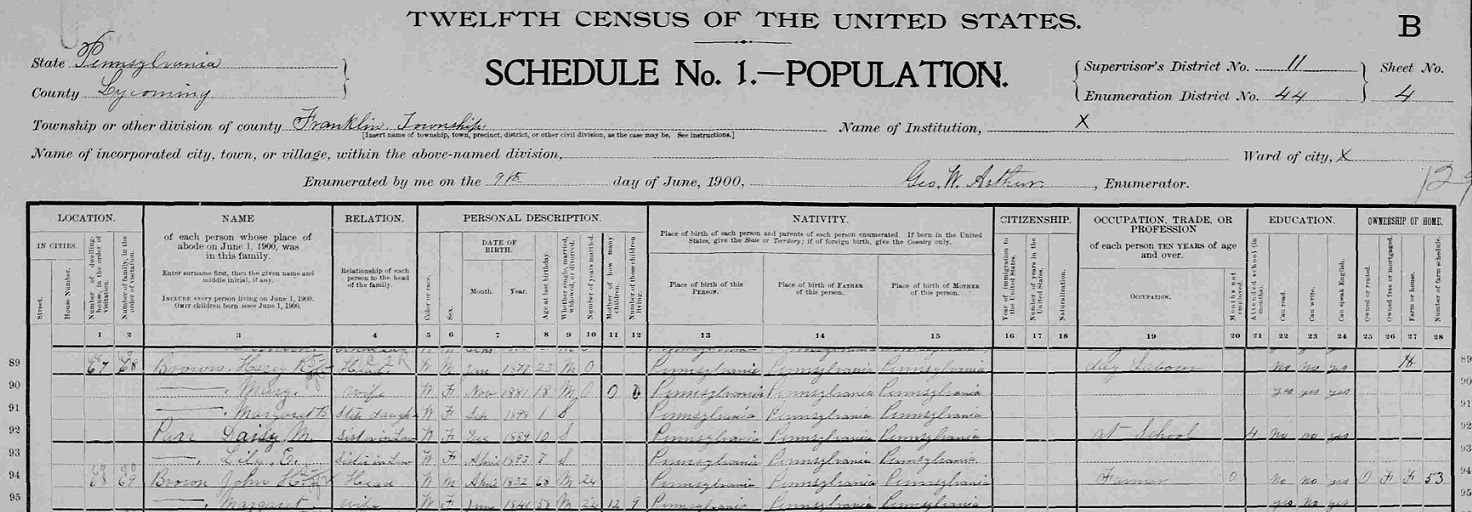
In the 1900 census, Harry remained in Franklin Township and was enumerated beside his parents, possibly in a house on his father’s property. In Harry’s household were his new bride Mary along with her two young sisters, Daisy, 10 and Lilly, 7. Also listed was an infant Margaret B. who was a few months short of two years. Margaret was recorded as a stepdaughter to Harry, raising questions about her parentage. Mary was listed as having no children, and according to their marriage application neither Harry nor Mary were previously married. It’s possible Mary had Margaret out of wedlock, and the enumerator listed zero children that Harry and Mary had together during their first few married months. It’s also possible that Harry was the actual father of Margaret, but since she was born out of wedlock, he put her as a stepdaughter. Looking at DNA matches, a possible descendant of Margaret is linked to me, which suggests Harry was the father.
Around 1908 the family moved to McIntyre Township in the northern part of Lycoming County. Family members have mentioned how relatives moved around in the early 1900s looking for work, and that was likely the reason for this move. Harry was now a woodsman as reported in the 1910 census, and the family rented a house. Beside Harry was his mother-in-law and her 2nd husband Wesley Temple who also worked as a woodsman. A few doors away on the next page, Harry’s brother Charles was listed working as a lumberman too.
During the first ten years of their marriage, Harry and Mary’s family had grown considerably; in addition to Margaret, six other children were listed: Leroy, Alfred, Melvin, Floyd, Francis, and Carl. The three oldest children attended school. Mary also had two children who had died before 1910: Ethel May who died in infancy and another child whose name has not yet been found.
In the 1920 census Harry was again in McIntyre Township, now renting a house in the town of Ralston. It’s not clear if he remained in the vicinity the entire decade, or like his brother Charles, he went up to the Finger Lakes region in New York for work. If Harry had followed his brother, he was not living there when the 1915 New York state census was taken. By the time he registered for the draft in 1918, Harry had taken to the mines in Ralston for work, perhaps due to a diminishing lumber industry.

Harry and Mary had two more daughters, Nellie and Flossie. Margaret, the oldest child, was now married and lived in Chemung County, NY. In 1920 the enumerator made an error recording the children; instead of writing Leroy, he incorrectly recorded a daughter, Laura, age 18. Besides there not being a daughter Laura, one clue this was inaccurate was the occupation listed. Laura (Leroy) and 16-year-old Alfred both worked as miners with their father. Except for Leroy, all the children attended school within the year.
Sometime after 1920 Harry moved the family to Indiana PA, where his brother Charles resided and worked. Harry likely made the move for better opportunities, as well as to be near family. As the 1930 census indicated, Harry continued to work as a miner. Unlike previous enumerations, this census recorded that Harry could read and write. If the previous censuses were correct, then Harry must have learned this during the decade of the 1920s.
Surprisingly, in the 1930 census Harry and Mary had separate residences. The 1930 census reported Harry rented a house for $2 a month in White Township, Indiana County, just a few doors away from two of his nephews, Alvin and Emery Brown. For Mary the 1930 census listed her living in the borough of Indiana with three of their adult children and rented a house for $15 a month. These separate living quarters might have been for convenience to where Harry worked, but I vaguely recall someone mentioned Harry and Mary may have had some marital difficulties. Perhaps this arrangement alleviated both situations.
Two years later at the age of 55 years, Harry died from what was believed to be liver cancer. His address at the time was 151 Oak Street in Indiana. Harry belonged to the Salvation Army, and an aunt had implied that this organization had helped the family when Harry was ill. I wonder if the address where he died might have been connected to the Salvation Army. Harry was buried in Greenwood Cemetery in Indiana PA. Mary remained in Indiana PA and resided with her children during the next two censuses on Church Street. She died thirty years after Harry in 1962 and was also buried in Greenwood Cemetery.
From the documents I have found for Harry, there are no big revelations. Rather, it appears he lived a rather quiet life. With a limited education, his employment opportunities were grueling manual labor, such as working in a lumber camp or the coal mines to support his family. I imagine as brothers, Harry and my grandfather Charles had a close bond, since they were found several times living and working in the same area. Although the census has given a peek at Harry’s life, there is additional information I hope to discover to form a more complete picture of his life and character.
 Relatively Speaking Blog