Day of the Dead is observed annually on November 2, especially by those of Mexican heritage. This celebration remembers and honors family who have passed on. A few years ago, the animated movie Coco focused on this holiday and told the story of Miguel, a 12-year-old boy, who crossed into the land of the dead, met some of his ancestors, and discovered their stories.
As a genealogist, I have added many names to my family tree, but I often lack the stories that make distant relatives come to life. Documents offer some clues about a person’s occupation, residency, or other tidbits, but often one must extrapolate these facts to create a bio for them. Sometimes 19th century county histories describe the accomplishments of early settlers, but these might include embellishments by the time these stories were chronicled by their great-grandchildren.
Obituaries, written at the time of death, represent a more immediate, and perhaps a better picture of a person’s life. Depending on the period it was written, it could provide greater insight than documents. Earlier obituaries usually only include the basic facts, but those written in the past 100 years often include greater details about the decedent’s life. Besides listing relatives, recent notices might mention places where one grew up, went to school, worshipped, or worked; occupation or trade; organization’s they were affiliated with; and even the interests and hobbies they enjoyed.
Some of the first obituaries that I encountered were those for my grandparents that my parents had clipped and tucked away in a small bible. When I became interested in genealogy, my Aunt Silveretta shared some obits that she had. Some she had cut from the local paper; others were sent to her by cousins, announcing the deaths of her aunts, uncles, and cousins. Other cousins have also shared obituaries with me as we worked together on common family lines.
Over the years I have acquired a lot of information and family stories through obituaries. Some libraries, like the Uniontown library, have catalogued obituaries found in the newspapers on microfilm that it houses. This make finding death notices for relatives quicker, especially when an accurate death date is not known or when death notices were printed throughout the paper and each page and column had to be reviewed for the deceased’s name.
While researching in Uniontown I located the obituary for Daniel Moser, printed in Genius of Liberty paper in August of 1889. Daniel died at age 86 years, and was born April 20, 1803 to Valentine and Barbara Moser, he being their 2nd son and the last remaining child. The paper noted his parents were of German descent, the dates his parents died and listed the first name of Daniel’s siblings. It went on to state he married Sophia Hartman, daughter of Melchi and Mary, on April 12, 1839. Daniel and Sophia had 11 children, all mentioned including his sons-in-law; it noted he had 45 grandchildren and 16 great-grandchildren. His obituary touched on his illness and how his wife nursed him, “as only a wife could” for the 18 months he was ill. Certainly, in this one obituary a wealth of family information can be gleaned.
For its time, Daniel’s obituary is rare in its detail. Before the 20th century, most death notices were sparse, with just a few lines, and typically listed name of deceased, when, and where they died. Occasionally, a spouse or one close relative, what they died from, or where they were being buried might be included. Even a small mention can be useful, specifically when death certificates were not issued. In these cases, the death notice becomes important as the only source for when a person died.
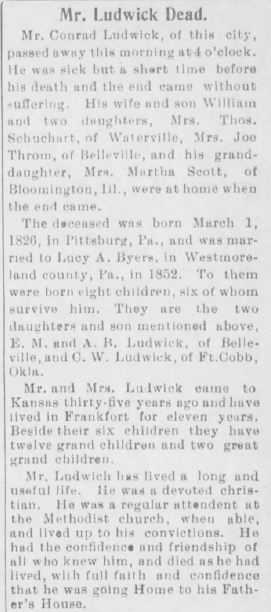
In the age of digitization, many newspapers have been scanned and are available online. Newspaper subscription services, like newspapers.com or newspaperarchive.com, make finding newspaper articles easier than skimming through microfilm. Some allow you to filter the search to include only obituaries. These sites have proven valuable in finding information on relatives who lived in areas outside of Western Pennsylvania, like my great uncle Conrad Ludwick.
Conrad, brother of my 2nd great grandfather John Ludwick, had moved to Kansas before 1880, and I wanted to find more information about him in that state. I searched over several years, occasionally finding a mention of one of his children, but never any details of when Conrad died. Eventually, the Frankfort KS newspapers that contained his obituary became available online, and I found three versions of his obituary. They revealed some new information to me. I learned his wife’s maiden name was Byers, they married September 7, 1852 in Westmoreland County PA, and that he was said to be “among the first to discover oil in Pennsylvania.” It also confirmed some information I already knew about him.
When no result turns up on the newspaper subscription sites, and I have a date of death, I sometimes visit the archived newspapers on Google. Although there is a search bar that opens a webpage with results of articles from all the papers, I usually go to the newspaper for the region where a relative lived and scroll through the pages for several days after the death in hopes to find an obituary. There are gaps in the available issues, but I have had success here when I was not able to find a notice other places.
Notices for recently deceased relatives can often be located online with a simple search of a person’s name and location of death. The returned results often point to various sites, such as legacy.com. Searches can also be done directly on the legacy site, but occasionally the notice is a simple statement of when the person died, and the link to the full obit is hidden behind a newspaper’s paywall. In these cases, visiting the website of the funeral home might yield better results, as most funeral homes have archived obituaries for at least a few years. Findagrave.com features burials and gravestones, which are added by members of the website. Sometimes, especially with more recent deaths, an obituary extract will be included, although it is often good to find the original in the newspaper to confirm nothing was missed in its recording.
Obituaries have been a great resource for filling out my family tree and can help pinpoint on which branch a person belongs. Additionally, these narratives may depict relatives overcoming adversity to achieve great successes, being an important participant in their community, or living a simple life while enjoying family and friends. Occasionally, they impart the tragedy of a life cut short either by illness, accident, or sometimes violence.
For the numerous relatives in my database, when I can add an obituary, these names begin to come to life. With these notices, I gain insight into the lives of relatives I never met. We all share many of the same struggles, hopes and dreams, and reading a few details about these relatives’ lives makes me feel more connected to them than just being related by some common ancestor. I have a deeper appreciation for all the different family members who are on the tree, and each time I come across their name and their death obituary, I can take a few moments to remember them and the life they once had.
 Relatively Speaking Blog