The census is a wonderful tool for family research. Although it is conducted every 10 years, it takes a lifetime to view yourself in these documents. The government analyzes and shares general statistics about the population shortly after the data is collected, but the actual forms are not released to the general public for 72 years. Last month on April 1st the forms for the 1950 census were released into the public domain. Anyone who turned 72 before April 1 of this year should be able to find themselves in those census records.
Although the enumerations are available, many of the forms are not indexed, so to find families one must leaf through each page to find them rather than using the familiar digital search. Since the release, Ancestry.com and FamilySearch.org have both been working to index the census and make it fully searchable online. They appear to be working in tandem, using computers and machine learning to transcribe the census records. Each site has information about its process; it is fascinating how they prepared and honed the computers to scan the records prior to the release for the best results.
On Ancestry one can sign up to be notified when indexing for a state of interest is finished. In the first few days there was no search capability, but now, one month later, Ancestry has activated search fields for the 1950 census, although it returns limited results. Only five states were indexed as of May 1. While the indexing is underway, Ancestry has an interactive map that allows you to locate an enumeration district for a known area. This provides a link to that district’s census records, where one can browse the pages of enumerated households for that location.
Using this tool I searched for my ancestors, Charles and Lucy Brown, who in the 1940’s moved to North 11th Street in Indiana PA. On the map I zoomed in on Indiana PA; you can also type in an address and city to retrieve the link. Moving through the streets I located 11th Street and found it was ED#32-69. Clicking on the link opened the forms and I went through page by page looking for the Brown family. The family was listed on page 11 of 20, with 7 people in the household.
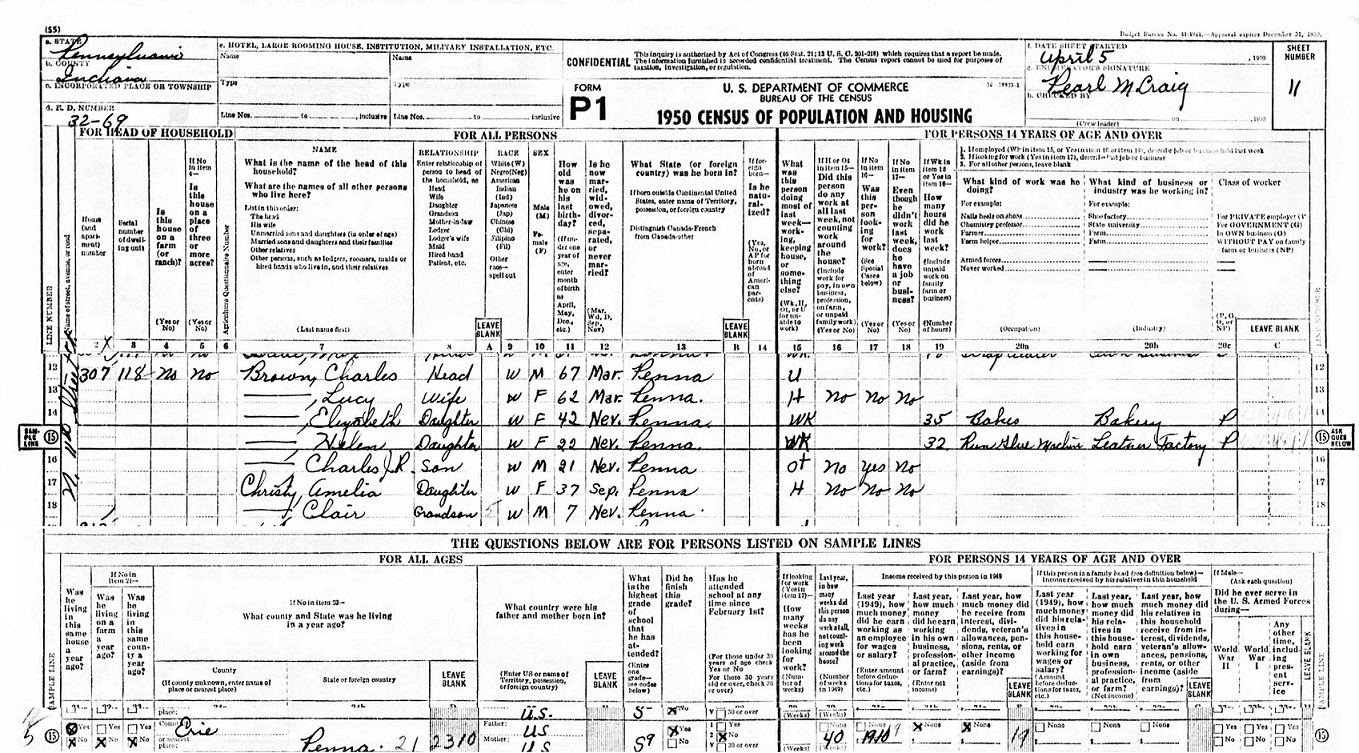
The information contained in the 1950 census includes the basic name, age, place of birth, relationship to head of household and marital status. A new question asks if the house is on a farm or ranch and whether it is on more than three acres. For persons over the age of 14, questions about employment were asked. Besides the usual occupation, these included questions about one’s work status and what they did in the past week. In the Brown household only two of the adult daughters were employed, one at a bakery, another at a leather factory.
Like the 1940 census, there was a random sampling of questions. Every fifth person was asked supplemental questions about where he was living a year ago, education, parents’ birthplace and additional employment questions. One person on each page was asked about number of times married, and if a woman, how many children she had. For the Brown family, Helen finished grade 9 and she had been living in Erie the year before but was now back home.
I decided to look for another pair of ancestors William and Marjorie Ludwick in Youngwood PA, but I could not find them. Youngwood covers ED# 65-394 to 397 and I searched the 31 pages of enumerations with no luck. I noticed there were a fair amount of “no one home” recorded and wondered if maybe the Ludwicks were in this group. It will be interesting to see how these households get enumerated and if they are listed in a completely new section. Once Pennsylvania is indexed, I will conduct a search to see if I have better luck on this line.
Turning to the FamilySearch site they have fully indexed several states in the month. Clicking on those states bring up a search box, and the results are limited only to the states that have been catalogued. In its effort to get all states completed, FamilySearch is recruiting the public to volunteer to review the transcriptions for accuracy. Anyone can assist with proofing the census, if only for a few minutes.
On FamilySearch’s 1950 Census project page, a user can choose a state to authenticate, with an option to add a surname–although the surname may or may not appear on the pages displayed. A page of the census opens with a dialogue box that displays a transcribed name. Volunteers then check whether the transcription is a match to the name highlighted on the census page. If the name does not seem to match—perhaps because of illegible writing—the volunteers can answer that they are unsure or they can edit the name to correct the transcription. It is a fairly easy process and by reviewing a few minutes here and there I have examined over 400 names. The computer’s precision is impressive. To learn more, visit familysearch.org.
I remember when the 1940 census was released ten years ago. There was a huge effort to index those forms as quickly as possible and within the first couple of months many of the states were finished and available for searching. Now with the first step of the transcription accomplished by computers, I expect most, if not all, of the 1950 census to be fully searchable before the end of May. Since several states have already been completed, other states will start to be added quickly. Pennsylvania at this writing is under 10% complete, but many of the western states are about 50% validated.
For those who don’t want to wait for the indexing on these two sites, the National Archives Record Administration (NARA) has the census online with a search capacity. However, in searching this site for Charles Brown above, I still had not located him after 5 minutes of adding criteria to the search fields. I found other ones, but not the ancestor I was looking for. It was quicker to use the Ancestry maps and scroll through the pages. But for states not yet indexed by the other two companies, the NARA site could facilitate finding some individuals in the enumerations.
It has been exciting viewing some of my family members and learning more about them through the 1950 census. I look forward to the next couple of weeks as more and more of the states are available for searching. Until this occurs, I will continue to assist the indexing project, especially for Pennsylvania. Who knows, maybe I’ll unexpectedly stumble across my Ludwick relatives. When everything is done, the 1950 census will certainly help me in filling in some gaps on my family tree. And for those between the ages of 62 and 71, you will have to wait another 10 years until the release of the 1960 enumerations to see your name listed in a census.
 Relatively Speaking Blog