Cemeteries are the resting place of the dead, and for a genealogist they are teeming with information. Gravestone inscriptions are a short bio about the deceased, often supplying name, birth and death information, relationships and sometimes even an epitaph. When relatives are in the same cemetery, the grave markers can reveal a family narrative. Perhaps it’s this richness that fascinates me when I walk through a graveyard reading the stories of the standing stones.
I am fortunate to have visited some of the graves of my maternal ancestors who settled in western Pennsylvania during the latter part of the 1700s. Some lived in the eastern part of the state or a bordering one before coming west. It is likely I have relatives to be found in every county of Pennsylvania, with great aunts and uncles, and their descendants who remained in PA. As I identify these relatives and place them in my family tree, I am always surprised when I discover a family connection buried in a nearby cemetery. Brush Creek near Irwin PA is such a place.
Before I acquired my interest in genealogy, I would never have guessed that Brush Creek Cemetery would hold much significance for me. When I was in high school, I occasionally accompanied a friend and her family to the United Church of Christ, one of the churches connected to this cemetery. I remember in high school a story about an old grave in there that had caved in displaying the decayed coffin and bones; but I never gave much thought about the cemetery. It was just a place where people were buried.
A few years later when I was in college my passion for genealogy was sparked, and cemeteries took on new meaning for me. After some time of researching I discovered that my high school friend’s family and I shared a common ancestral connection. My 2nd great grandmother Esther Rugh was a sister to their ancestor Caroline Rugh who married into the Kline family. As I researched our shared relations, I visited the Brush Creek Cemetery and found Kline descendants buried there.
The Brush Creek Church has a long history dating back to the Revolutionary War period; its congregants were the early settlers of Westmoreland County PA. According to the book, Brush Creek Tales by C.M. Bomberger, the German Lutheran and German Reformed churches shared a log school/church that was burned by Native Americans in 1782. A new building was erected and in 1783 Rev. Weber was selected as the minister for the Reformed congregants. Weber was one of many ministers who kept excellent baptismal records that are part of a four-volume collection of the German Church Records by the late Rev. Paul Miller Ruff. Eventually the two denominations built their own buildings near each other. The cemetery used by both holds many old graves and its own history.

The cemetery was established in 1782. Bomberger mentions that many pioneer settlers were buried here; I suppose those graves from the 1700s never had proper markers or the stones no longer remain, having deteriorated over time. When doing research for my cousin, I found their ancestor Barbara Cline buried in 1829 with the stone in decent condition. A few other Clines were buried a couple of years before her. Next to Barbara was a stone that had been broken and was partially buried, making it impossible to tell whose it was.
Around the 1970s, Della Reagan Fischer, as well as some other researchers, began to compile church and cemetery records in Westmoreland County into printed books. Fischer printed numerous books including Brush Creek Lutheran and Reformed Churches Cemetery, which lists the stones she and her husband read in 1971. She notes, “Many graves no stones”; these were probably those of the old pioneers. I was curious what might be the oldest tombstone still standing in this cemetery. Fischer’s book lists some other burials with stones in 1820s and one in 1817, but over the past 50 years, it’s possible some of the stones she read no longer remain. As for the dilapidated stone by Barbara Cline, it’s possible that it was for John Cline; Fischer listed his stone was underground and that he died Nov. 30, 1815.
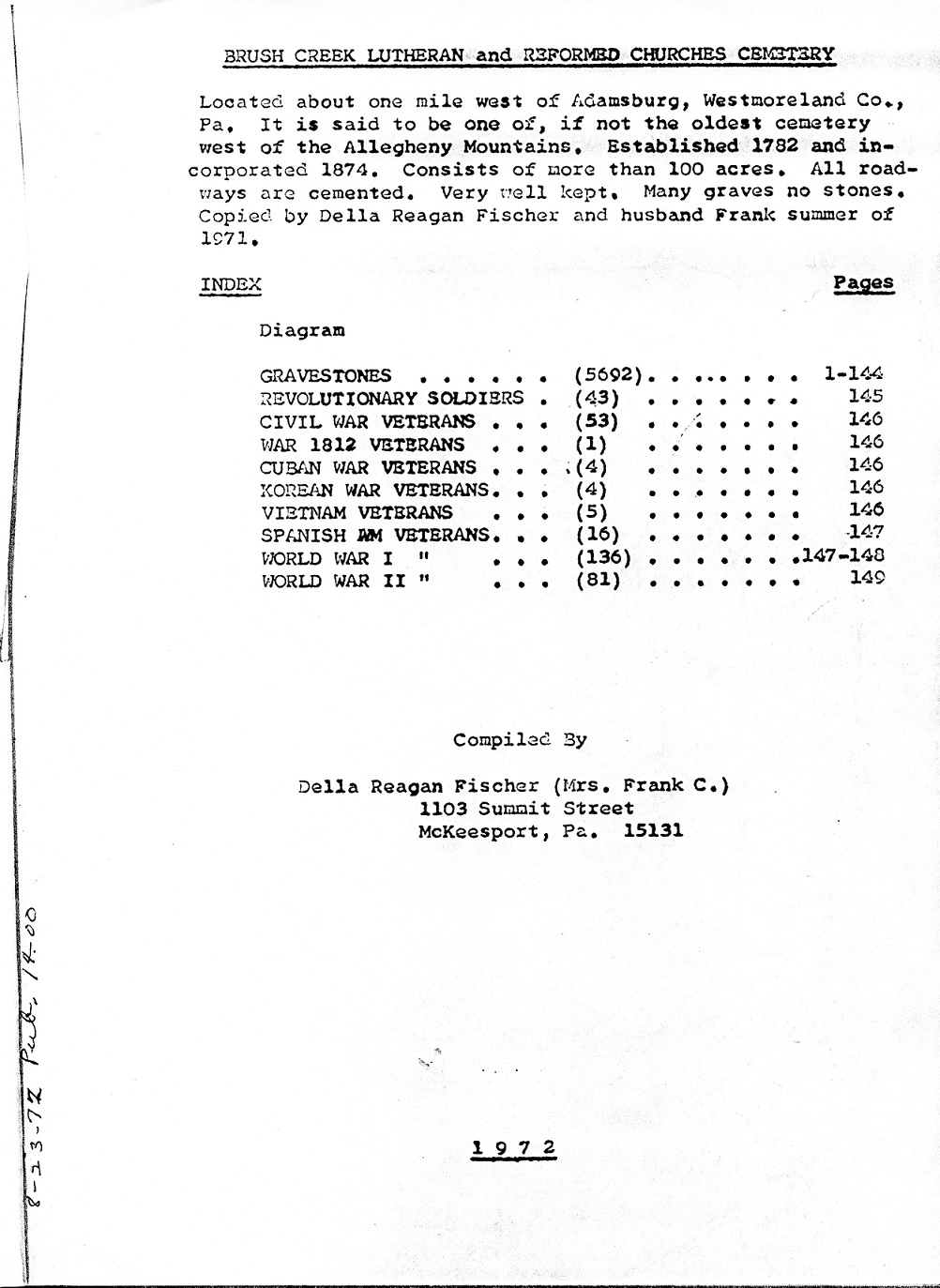
In addition to the cemetery book, Fischer, and other researchers like Rev. Ruff, compiled records from the Brush Creek Churches into valuable resource books for family history buffs. These include various marriages, baptisms and deaths ranging in years from the 1790s into the early 1980s, although the records might not be all inclusive. The German Church Records, translated by Rev. Ruff from the original German baptismal records of Rev. Weber and others, listed the child, parent and any sponsor. Ruff’s books are a valuable resource for those researching the early period of Westmoreland County.
Glancing through the Brush Creek book, I found some of the older Rugh family buried there. These included my 3rd great grand aunt Magdalena Rugh Baughman (1777-1834) and her husband Adam (1773-1840). I also found a Catherine Rugh Smith, (1757-1828), said to be a daughter of my 5th great grandparents; someday I hope to verify this. There are also about 10 other Rughs listed as buried here; these are likely cousins whom I need to fit into the Rugh tree, including a few recent ones who died in the past 25 years.
I also discovered relatives from my Ludwick line buried here. Peter Helman (1821-1860) was the son of Daniel Helman and Catherine Ludwick, my 3rd great grand aunt. Peter, who was well established in the Irwin vicinity, was buried in Brush Creek, along with his wife Hannah (1826-1902) and their children. Even some of Peter’s grandchildren and great-grandchildren were buried in Brush Creek. Fifty years after the Fischer book was printed, it is not unlikely that another generation of Peter’s descendants are now included in the family plot. I hope to visit the cemetery sometime to locate these graves of my relatives.
I am fortunate that many cemeteries in western Pennsylvania hold family connections for me and that I can visit a relative’s grave to pay tribute to their life. Recorded cemeteries are a terrific aid for the family researcher who might not have the same opportunity. The efforts of Fischer over a half century ago ensure that the inscriptions, especially for stones that were already in disrepair when read, will not be forgotten to time, but will continue to provide family researchers with evidence of an ancestor’s burial. Genealogists are fortunate that someone as dedicated as Fischer documented cemeteries in western Pennsylvania. With Fischer’s books as a guide, I look forward to discovering more relatives buried in Brush Creek and other cemeteries around western Pennsylvania.
 Relatively Speaking Blog