Whereas Veteran’s Day in November honors all men and women who have served in the United States military, Memorial Day in May commemorates those whose lives were lost in the line of duty. With restrictions due to Covid19 in place, Memorial Day 2020 celebrations in many areas will be quieter than other years with no parades or ceremonial gatherings. Nevertheless, on May 25, I will be remembering veteran David B. Ludwick, my 2nd great granduncle, who was one of the more than 620,000 casualties of the Civil War.

Memorial Day started after John A. Logan of the Grand Old Army asked the nation to remember the fallen men who served in the Civil War. At one of the first ceremonies on May 30, 1868, James Garfield delivered a speech at Arlington National Cemetery and afterward the graves of more than 20,000 Union and Confederate soldiers buried there were decorated. For many years, it was observed on May 30, and often was referred to as Decoration Day, since family members planted flowers and adorned the graves of lost soldiers. As the tradition continued, Memorial Day grew to pay tribute to soldiers killed in subsequent wars. More than 100 years after its first observance, it became a federal holiday in 1971 and is now observed on the last Monday of May.
David Ludwick was about 25 years old when he was killed in battle. He was the youngest known child of Abraham and Mary Ludwick, who after their marriage lived in Westmoreland County, PA until about 1836 when they moved to Jefferson County, PA. David was born about this time, so his birth could have happened in either county. He grew up and attended schools in Jefferson County. Sometime in the late 1850s the family moved back to western PA and settled in Wilkinsburg, Allegheny County, PA.
David, a carpenter by trade, was on his own by 1860 and lived in McKeesport, PA where two of his brothers, John and Conrad, resided nearby. In that year’s census his household included Ann M. Ludwick, 25, and Mary Lewis, 10. Ann, born about 1835, was most likely David’s wife, and they were probably married a few years at most. She was reported as having an occupation of ‘tailoress’. Online searches have not yet provided any clues of when or where they married, or whether they had any children. Ann, widowed in the summer of 1862, likely remarried, making it difficult to locate her in later years.
Mary Lewis, also in David’s household in 1860, perhaps had some connection to either David or Ann. Ancestry.com suggested she might be Mary Lewis, daughter of Eliza Foight and Joshua or Josiah Lewis, who married Philip Hamilton. However, nothing confirms this Mary Lewis is the same person in David’s household. David’s older brother George married Margaret Lewis of Jefferson County; were Mary and Margaret related? Or was Mary a younger sister to Ann, making her a Lewis as well? No evidence has yet been found that associates Mary, or even Ann, to any other Lewis family. Further research could determine whether Mary holds any clues to Ann and her parentage.
David resided in McKeesport just over a year longer until his enlistment with the Union Army on August 1, 1861 in Pittsburgh for a three year period; it is unclear whether he volunteered or was drafted. According to his pension file David was 24 years old from Wilkinsburg, Allegheny Co., PA at the time he went into the army. David had grey eyes, sandy complexion, and was 5’5 ½” tall. David was mustered into service August 26, 1861 as a private in Col. Hays’ 63rd Regiment, PA Infantry, Company A. Over the course of the war the 63rd lost 186 soldiers who died from combat wounds and 134 men who died from disease.
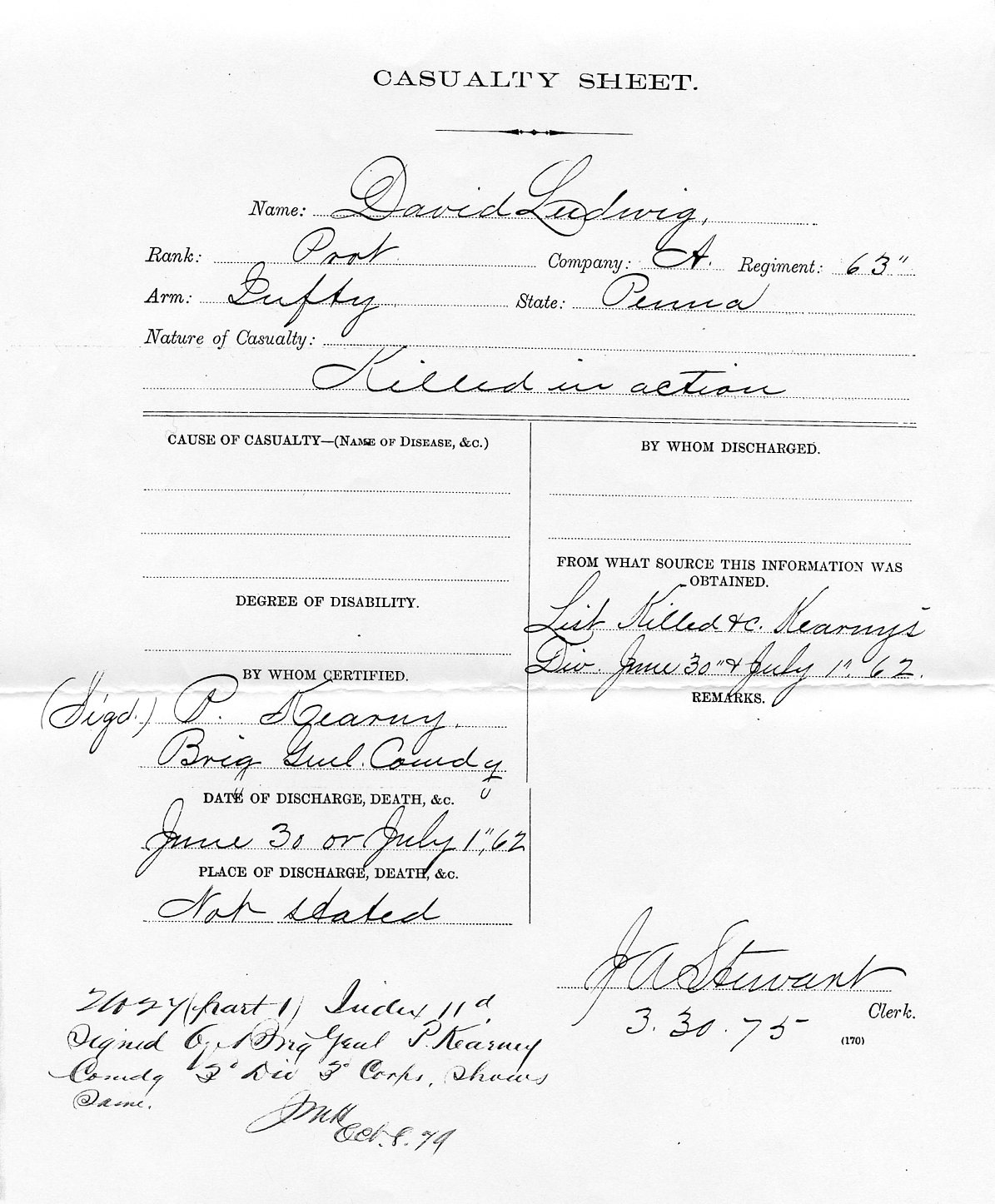
Wikipedia details some of the deployments for this regiment. They spent the first eight months defending the capital in Washington D.C. until March of 1862. Then the troops moved out and engaged in numerous combats, including the Battle of Williamsburg, Battle of Seven Pines, Battle of Fredericksburg and Battle of Gettysburg, among others. David was involved in the Seven Days Battles from June 25 to July 1, 1862, which was fought in Virginia near Richmond. On the sixth day June 30, 1862, David joined the ranks of the 297 killed during that day’s Battle of Nelson’s Farm. The Casualty Sheet in his pension file provided no additional information about his death or where he was buried, though it is possible David was buried in Glendale National Cemetery in an unnamed grave. This form was signed by Brigadier General Philip Kearny, who was killed in action two months later.
These fragments offer a vague impression of David’s life, but clearly, at age 25, his life was cut short by the ravages of war. I hope to learn more about David’s life, including his final resting place to have an opportunity to decorate his grave. In the meantime, especially this Memorial Day, which marks the 50th observance since designated a federal holiday, I will quietly remember my grand uncle—as well as others—and honor the sacrifice he made for his country so that all persons shall be free.
 Relatively Speaking Blog