The 24th decennial U.S. Census in 2020 is now underway. In March letters were sent to all residences to collect information of who lived there on the designated date of April 1, sometimes referred to as census day. The first of April has been census day for many recent enumerations, although this date has varied. A new initiative this year is to have responses returned electronically via online forms; answers can also be submitted by phone or by mail, which was introduced in 1960. If no completed form is received, an enumerator will visit to collect the information, although Covid19 might disrupt these attempts.
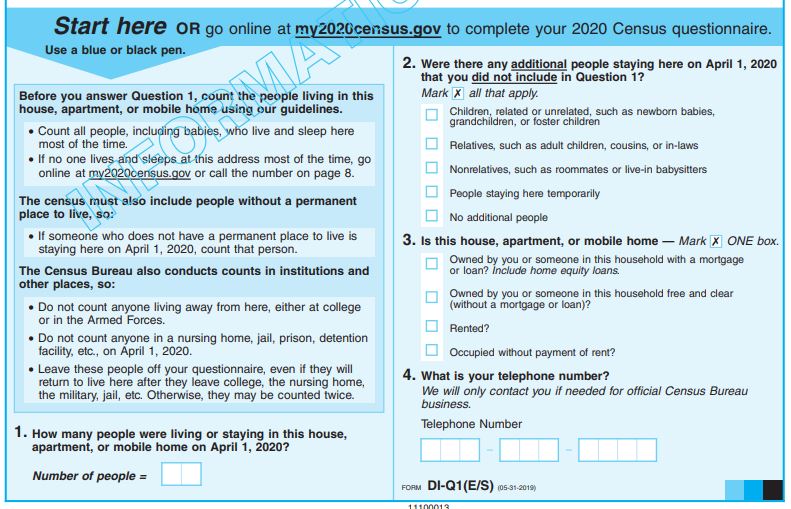
The census is a provision in the United States Constitution, Article 1, Section 2, which states:
Representatives and direct Taxes shall be apportioned among the several States which may be included within this Union, according to their respective Numbers, which shall be determined by adding to the whole Number of free Persons, including those bound to Service for a Term of Years, and excluding Indians not taxed, three fifths of all other Persons. The actual Enumeration shall be made within three Years after the first Meeting of the Congress of the United States, and within every subsequent Term of ten Years, in such Manner as they shall by Law direct. The Number of Representatives shall not exceed one for every thirty Thousand, but each State shall have at Least one Representative…
Conducted every ten years starting in 1790, every census has the primary purpose to record the number of residents living in the United States. Each census different questions are asked to gather additional statistical data. The first population count listed only the head of the household with a tally of free white males 16 or older, free white males under 16, free white females of any age, along with the number of slaves or other free persons. From 1800 to 1840 age categories expanded, providing better demographic information. The inclusion of each household member’s name with their age and place of birth occurred in 1850. People’s relationship to the head of the household, as well as their parent’s place of birth, were added in 1880. In 1900 a person’s birth month and year was asked, and if applicable the number of years married and how many children a woman had. In 1940 two people on each page were asked supplemental questions for a random sampling. This year is the first time that relationships include data on same sex couples.
The census is a useful resource for genealogists. With a range of information, viewing ancestors in the census over their life span can provide details about their life, residences, wealth, and family connections. The completed forms are released to the public after 72 years, with 1940 and prior years accessible online or at certain libraries; 1950 will be released in two years. Unfortunately, not all of the returns are extant. Most of the 1890 census was destroyed in a fire. Other regions in the country might also have gaps where the census is missing for any variety of reasons, such as in Monongalia County Virginia for 1790 and 1800, as I discovered in my research.
Although the 2020 census will not be available to the public till the year 2092, the collected data will be compiled promptly to determine representation in the U.S. Congress. It will also be used to calculate the amount of tax dollars dispersed to districts for education and other services based on a region’s population. These causes make participation in the census mandatory to ensure that communities get their proper apportionment.
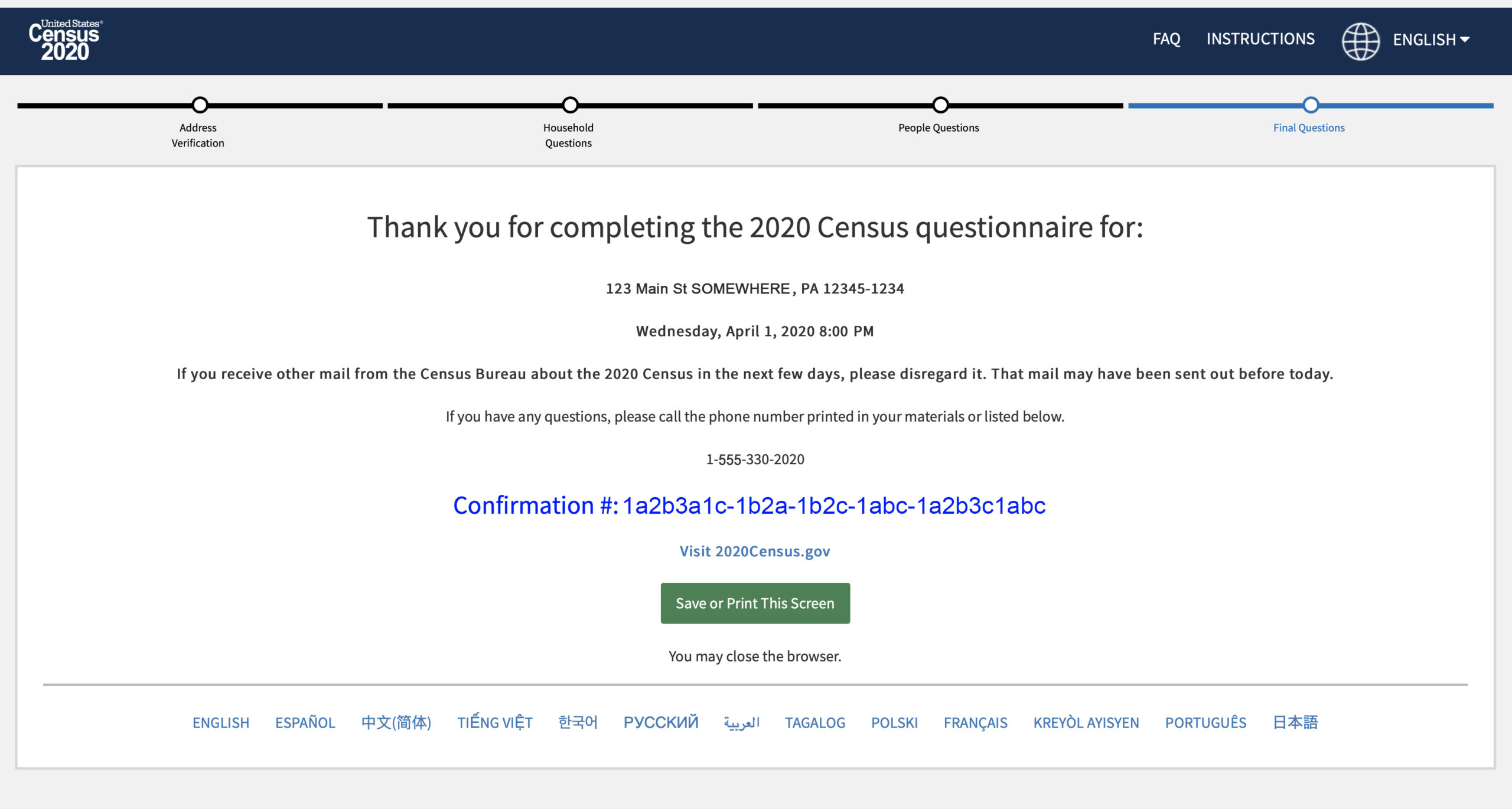
On Census Day we did our civic duty and filled out our questionnaire online; it was easy to complete and took just a few minutes. Years from now, future genealogists will be able to search and find our names among those who lived in Pennsylvania on April 1, 2020. But more importantly, our community will immediately benefit by our participation with distribution of government funds and local representation as our founding fathers intended. If you haven’t completed your return, don’t wait; perform your constitutional obligation and be counted by completing your census now.
 Relatively Speaking Blog