Deeds are documents that show ownership of land and record the transfer of property from one party to another. In Pennsylvania, as well as other states, they are managed at the county level by the Recorder of Deeds office. Each one contains basic information, such as the names of the parties, date of the agreement, a description of the land—often including neighbors—and the amount for which the property was sold. When a land holder dies intestate—or without a will—the property transfer might be the only reference of the decedent’s death. This was the situation for my second great-grandmother, Mary Brown, in Lycoming County, PA.
Mary and her husband Phillip Brown settled in Lycoming County, PA sometime before 1850. The 1850 census listed Mary and Phillip in Franklin Township with seven children and $300 in real estate. Phillip appeared in the tax rolls for 1856, but in the 1860 census Mary was the head of the household, indicating he had died between these two events. In 1860, five of Mary’s children lived with her, and her real estate value had increased to $1000, suggesting that more land had been acquired. Ten years later in the 1870 census, Mary still resided in Franklin Township, with son John in her household; her real estate value remained at $1000. Mary was not listed in the 1880 census.

A search in the Orphan’s Court of Lycoming County turned up no will for Mary or Phillip. Since three enumerations denoted they owned property, a search for Phillip and Mary was conducted in both the Grantor (seller) and Grantee (buyer) indexes in the Lycoming County Recorder’s office. Neither were listed in the indexes for any property sales between 1840 and 1870. A wider search listed a few Browns conducting land transfers in Franklin Township after 1870. Two instruments in Deed Book 74 caught my attention: John H. Brown, Mary’s son, along with others, sold land in Franklin Township in 1873 to a Mary Brown, and at the same time Angeline Brown, John’s wife, had bought land in that township.
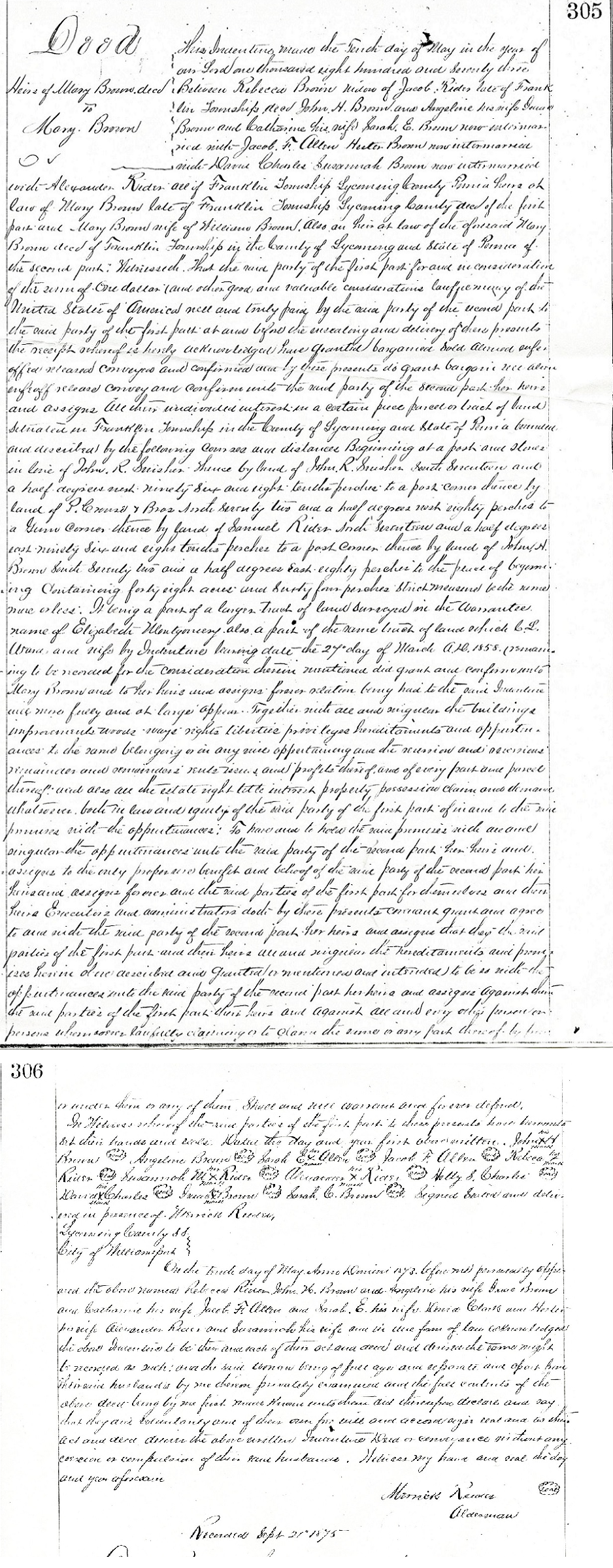
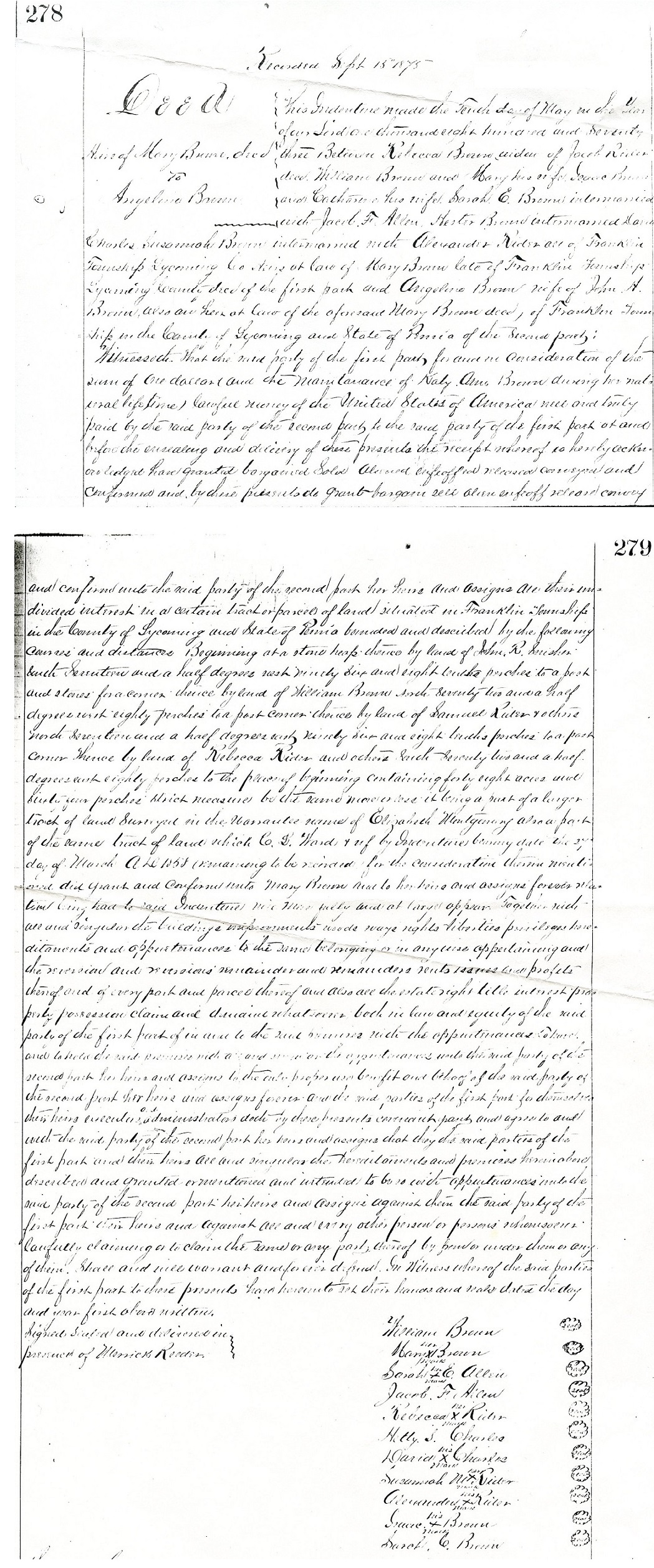
To the records room I went to see what answers each deed might reveal. Both were dated May 10, 1873 and the sellers were the heirs of Mary Brown, deceased. The buyers were two of Mary’s daughters-in-law: Angeline, wife of John Brown and Mary, wife of William Brown. With no other records found to document Mary’s passing, these deeds narrow her death to sometime probably in late 1872 or early 1873. Mary was about 65 years old when she died intestate, leaving her children to handle the remains of her estate.
As evidenced by these recorded deeds, Mary indeed owned real estate, almost 100 acres of it. Reading through the documents revealed that each property was “part of the same tract of land which C.L. Ward & [wife] by indenture bearing date the 24 day of March AD 1858 (remaining to be recorded) for the consideration therein mentioned did grant and confirm unto Mary Brown and to her heirs and assigns forever…” It was never indexed since it was not written in the deed books. These two deeds, not recorded until over two years later in September of 1875, most likely contained the only reference to the transaction of Mary buying land from C.L. Ward seventeen years earlier; whether Phillip was also a buyer at the time was not evident.
Wills usually mention the decedent’s children, but since no last testament was left, these two deeds provide an ample substitute. Both listed Mary’s children and their spouses, namely: Rebecca, widow of Jacob Rider; John H. who married Angeline; Isaac married to Catherine; Sarah E. married to Jacob F. Allen; Hester ‘now’ married to David Charles; Susannah married to Alexander Rider; and William who married Mary. Another daughter, Catherine, referred to as Kaly Ann, was mentally challenged as recorded in several census enumerations. Perhaps a verbal request of Mary before she died, a stipulation to the terms of sale was for Kaly Ann’s care to fall to Angeline, but unfortunately, Angeline died less than a year later.
The purchase price for each tract was $1, and I find it curious that Angeline and Mary, both sisters-in-law to the heirs, were the ones who purchased the property, rather than their husbands. Each tract was 48 acres and 64 perches, a sizable portion of land. Perhaps the other children had received a share of their inheritance before their mother died, or maybe other conditions or agreements were made between the siblings that were not part of the legal record.
One detail provided by the deeds was the location of Mary’s acreage. It adjoined John R. Swisher’s farm, which was near the Stoneheap Church according to property maps. Neighboring land owners also included P. Crouse and brothers, Samuel Rider and others, as well as Rebecca Rider, Mary’s daughter. Examination of deeds for property surrounding Mary’s, such as Rebecca Rider’s, might disclose some useful information. Unfortunately, Lycoming County, unlike other Pennsylvania counties, have not made their information available online, so further research must be done with a visit to Williamsport.
Every document located for an ancestor helps to enrich his/her story and create a more complete picture. Census, tax records and deeds can all help to determine if a person owned property. For Mary Brown, these records offered some small, but significant details about her life. Although particulars about Mary’s death, or her last wishes are currently unknown, these two transfers offer some insight and help to narrow a searchable timeframe for more evidence.
 Relatively Speaking Blog