Probate records often contain significant information and provide proof for particular family facts. Wills are probably the most widely known type of probate records. A person who creates a will, called a testator, gives a directive for what items after his death are left to whom, often mentioning names of children, or relationship of any named heirs. Witnesses, especially for older wills, usually were a relative or friend of the testator and could aid in supplying additional clues about the family.
After the testator dies, the will is presented to the proper authorities to begin probate of the will, often with statements of the witnesses to prove the validity of the signed document. Next Letters of Administration are granted to the named executors of the will, giving them authority to carry out the wishes of the descendant. An inventory of the estate is made, and items are then distributed to the named parties and recorded. The settlement of a will can take several years to complete.
When a person dies without a will, there can be a void of information about the deceased person. If he owned property, there might be Letters of Administration filed with the court. This allows the appointed person to act on behalf of the decedent to settle the estate and distribute property to the rightful heirs. If the deceased had no possessions, then no probate records would be found, although there might be a request for guardianship of any minor children surviving.
Probate documents are found in the Register of Wills or Orphans Court records in county courthouses. Will Books record each instrument by a testator that has been brought before the authorities to be registered. Other supporting papers found in the courthouse include Letters of Administration, Distribution Lists, and Inventory List, giving some additional insight into the deceased possessions. On rare occasion something might be found in these records, like that of the settlement of the estate of Henry Brinker, that doesn’t fit the typical probate process but provides some genealogical information as well as interesting insights about family dynamics.
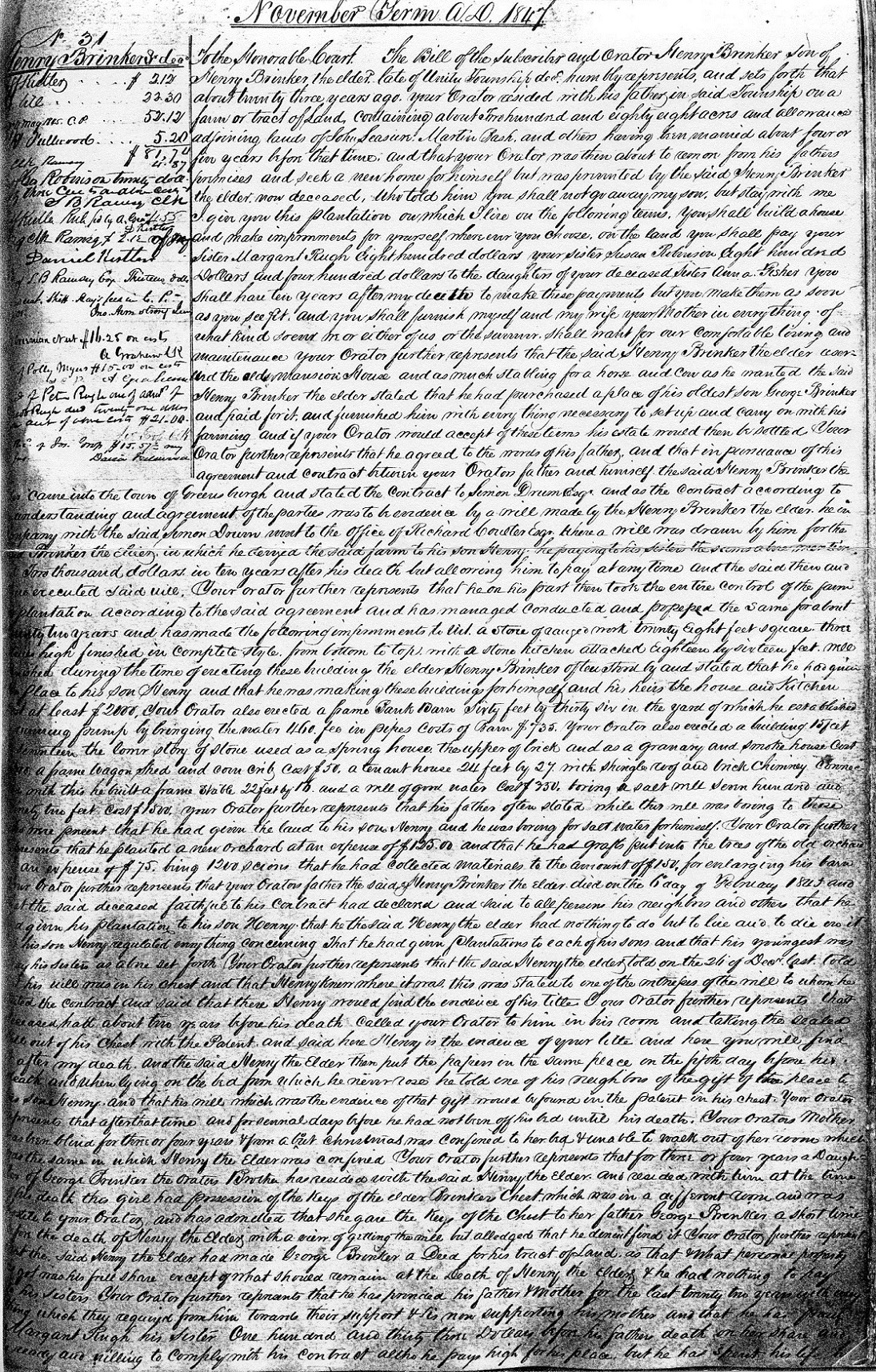
No will is recorded for my ancestor Henry Brinker. However, within days after Henry’s death on February 6, 1845, his son, Henry Brinker, Jr. filed a lengthy petition which is recorded in the Orphans Court books, Volume 3 page 303. From the first part of his petition we glean that about 1823, Henry Jr. and his wife of a few years resided with his parents in Unity Township, but had decided to move to their own place to raise a family. Henry Sr. said to his son, “You shall not go away my son, but stay with me. I give you this plantation on which I live on the following terms…” The first was for Henry Jr. to build a house and make improvements on the land. The next was to pay within 10 years of the father’s death money to his two married living sisters, Margaret Rugh and Susanna Robinson, and also to the daughters of his deceased sister, Anna Fisher— indicating that Anna must have died before 1823. The last term was to care for his parents during their remaining life. Henry Jr. agreed to the conditions and his father went to Greensburg to draw up a will with these terms outlined in it.
Continuing on, Henry Jr. lists improvements that he had made on his father’s homestead per his agreement. He adds that his older brother, George, had received from their father a deed for property which was purchased by their father with all the necessities for farming, alluding to this as his brother’s inheritance. Henry Jr. asserts that his father declared to neighbors and others that Henry Jr. would receive the plantation at the elder’s death. Two years before his father’s death Henry Jr. states his father called him into his room and “taking the sealed will out of his chest with the patent and said, ‘here Henry is the evidence of your title and here you will find it after my death.’” Henry Jr. also recounts “on the fifth day before his death and when lying on the bed from which he never rose [his father] told one of his neighbors of the gift of the place to his son Henry and that his will which was the evidence of that gift would be found in the patent in his chest.”
So what happened to the will? Reading on we learn that an unnamed daughter of George Brinker’s had also resided in Henry Sr.’s house for several years before his death. She apparently had access to the keys to the chest, which was not in her grandfather’s bedroom, and granted her father access to the chest; however, George had told her he didn’t find the will. Whether George lied about not finding his father’s will, or if he did indeed take it and destroy it, we’ll never know. But this petition indicates that George did look, suggesting some tensions between the brothers.
Henry Jr. closes his argument with the assertion that he had fulfilled his father’s terms. He requested of the court that the heirs of Henry Sr. be subpoenaed to testify about what they knew of the will and that a deed and title for his father’s land be decreed to Henry Jr. This petition bears two dates in February 1846.
A note in the court record shows that subpoenas were issued in April of 1846. Details of the full proceedings are unclear as only a few brief notes follow the main petition of Henry Jr. From these it appears that George Brinker might not have answered the subpoena, but others had. It was the November 1847 Term, when a full hearing appears to have taken place. The note for February 29, 1848 states that “Jacob Rugh and Adam Fisher execute and deliver to said Henry Brinker a deed of conveyance for the tract of land in said Bill or petition mentioned situate in Unity Township Westmoreland County”, indicating that Henry Jr. won his petition to the court. Since no will was ever recorded, it seems likely that Henry Jr. won from the testimony of others about his father’s intentions in the missing will.

 Relatively Speaking Blog