2017 marks the 100th anniversary of the United States entering the Great War, more commonly known as World War I, which impacted many of our ancestors. It began on June 28, 1914 when a Serbian nationalist assassinated Austrian Archduke Ferdinand; a month later Austria Hungary declared war on Serbia. A few weeks later this regional conflict had escalated into a full scale war as most European countries had entered the fray, with the larger powers of Germany, Britain and France bearing much of the burden and casualties. Over the next three years as the war raged on with no end in sight, the possibility loomed that America might be pulled into it.
Throughout the war’s first couple of years U.S. President Woodrow Wilson continually affirmed the country’s neutrality. Both Britain and Germany were against the U.S. supplying the other with materials that could be utilized for war. Britain, still a maritime power, kept American ships from reaching ports where supplies could be diverted to Germany. Germany, unable to receive U.S. supplies, used U-boats to keep resources from being shipped to its enemies by sinking vessels suspected of carrying weapons. Tensions between Germany and the U.S. increased, and the tipping point came in March 1917 when German U-boats sank several American ships. A few weeks later the U.S. Congress declared the country at war with Germany. The lives of many young American men was about to take a drastic change.
Although America was thrust into war, the country lacked the necessary resources to conduct it. Manufacturing sectors had to first build plants and assemble a labor force to produce tanks, ships, guns, ammunition and other military supplies like uniforms. Also needed was a sufficient supply of men for troops, which then had to be trained for combat. Debate ensued about conscription to more quickly grow the military beyond volunteers and in May 1917 congress passed the Selective Service law requiring men to register for a draft, which occurred in three phases.
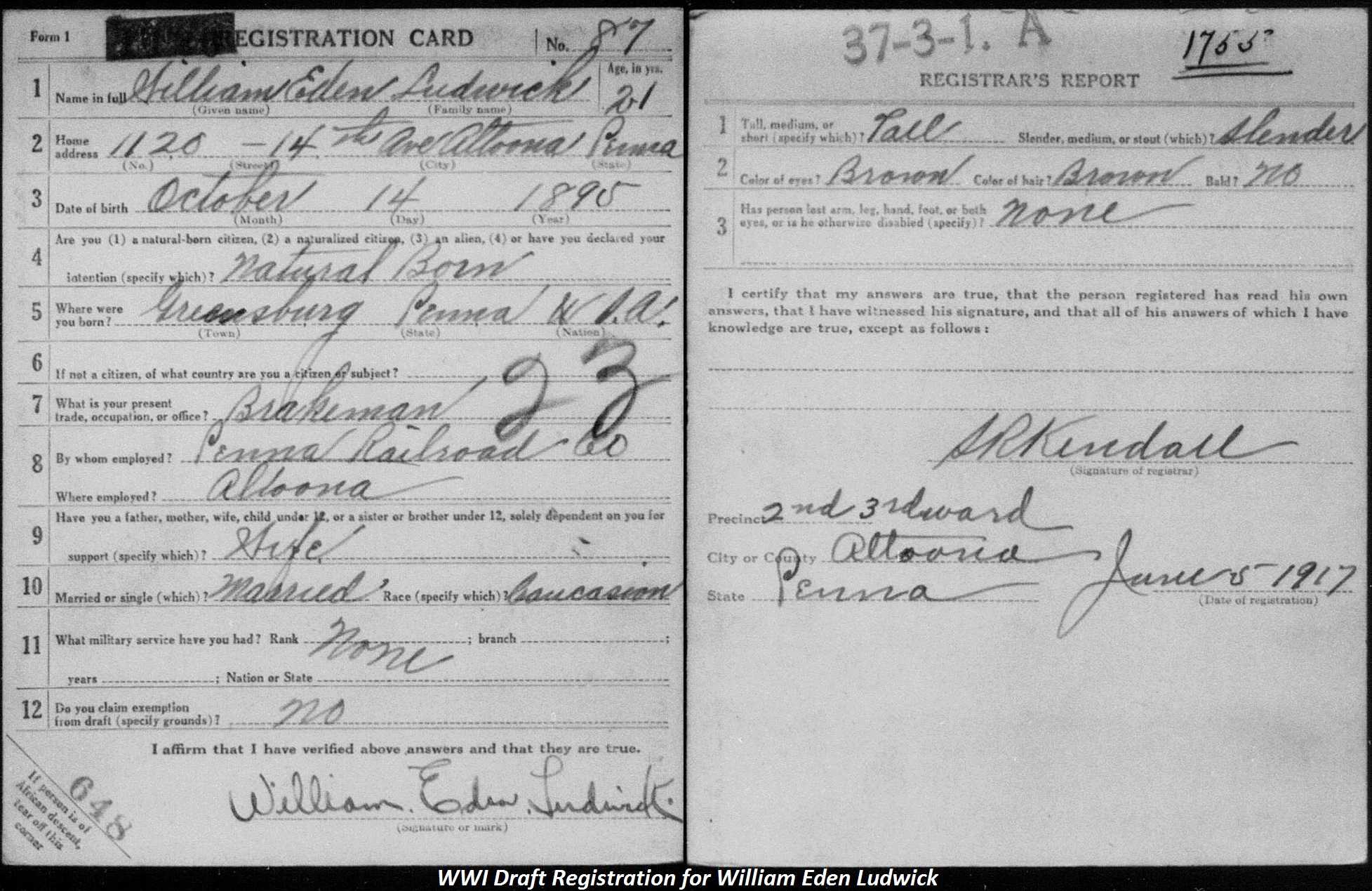
The first registration period deadline was June 5, 1917 for men ages 21-31. My grandfather, William Eden Ludwick was among this group of registrants. William had turned 21 the previous fall, and was still a newlywed, having only been married five months prior. He was described as tall and slender with brown hair and eyes. He worked for the PA Railroad and resided in Altoona PA. Although William wasn’t selected to serve in the military, his work transporting manufactured goods across the state’s railways was a vital part of the war effort.
The second round of registrations came one year later on June 5, 1918, for males born between June 6, 1896 and June 5, 1897, as they had turned 21 years of age during that year. A supplemental registration occurred in August to find additional males who had newly reached conscription age in those preceding two months. Two of my distant cousins, Charles Fowler and Floyd Rider, were part of the second phase. Both were unmarried. Charles had missed the first registration in 1917 by being a few days shy of 21; now he was almost 22, residing in Smithfield PA with his family. Charles had dark brown hair and brown eyes, and was tall with a slender build, and employed with a coal coke company. Floyd, part of the supplemental registration, had turned 21 years old a few weeks before his registration on August 24 1918. Floyd had a medium height and build, blue eyes and light brown hair and was living on his own in Montgomery PA where he was employed by John Meyers—no occupation was listed.
The third and final round of registrations took place on September 12, 1918, with the age requirement now widen to include not only those who had turned 21 in the previous few weeks, but also for any male up to age 45. My other grandfather Charles Brown can be found in this final conscription campaign. He was 35 years old, married with 5 children; his wife was about to deliver their sixth child in just a few days. Charles had a medium height and build, blue eyes, and light brown hair; he worked as a miner for Ralston Coal Company in Ralston PA. Both of Charles’ full brothers, who also worked in Ralston, were registered this day with descriptions similar to their brother. Harry was also a miner and George a woodsman although his employer was based in NY.

Many of the draft registrations are available online at familysearch.org. For the family genealogists these records can be a useful source of information. Questions about basic facts such as a full name or birth statistics, not recorded elsewhere for many born between 1886 and 1896, might be confirmed with the registration. A brief physical description indicated the person’s appearance. Some forms included a nearest relative, identifying family relationships. Addresses for these family members, if listed, as well as the registrant’s address established where they were residing at the time. Each piece of information can assist a researcher on where to look for other documents.
Between June 1917 and September 1918 over 24 million men registered for the selective service as required by law. From this pool of candidates, almost 3 million men were called to serve in the army, and of those who were sent to the front lines and fought over 50,000 lost their lives in the brutal battles. An additional 200,000 men sustained injuries from combat. Of the registered men mentioned above, none, to my knowledge, were drafted and thus spared from experiencing the horrors of this war that ended in November 1918.
Some background information on the war and draft registrations found online at: https://www.archives.gov/research/military/ww1/draft-registration https://en.wikipedia.org/wiki/World_War_I
 Relatively Speaking Blog