When I was in college—before my passion for genealogy developed—my walks to town took a shortcut through a cemetery. However, I ended up lingering to read the inscriptions on the stones, identifying who was related and imagining what these people’s lives might have been like. I remember a row of markers from the 1860s for one family: a father, a mother and several of their infant children who died within a few years of each other. I considered the sorrow this family felt and wondered whether illness or accident caused the children’s deaths.
A few years later when I began doing genealogy the value of gravestones to fill in gaps was apparent. A tombstone is like a brief synopsis of one’s life. Before birth and death records were standard, or if early records were destroyed, the tombstone, for those who could afford one, often supplied these vital dates—even if not always accurate. Family plots aid in identifying relationships since kin are buried near a surname marker. Also a cemetery might hold the only evidence that an individual lived, especially for children whose birth and death occurred between census years and no other record exists for them. Certainly a graveyard can benefit genealogy research.

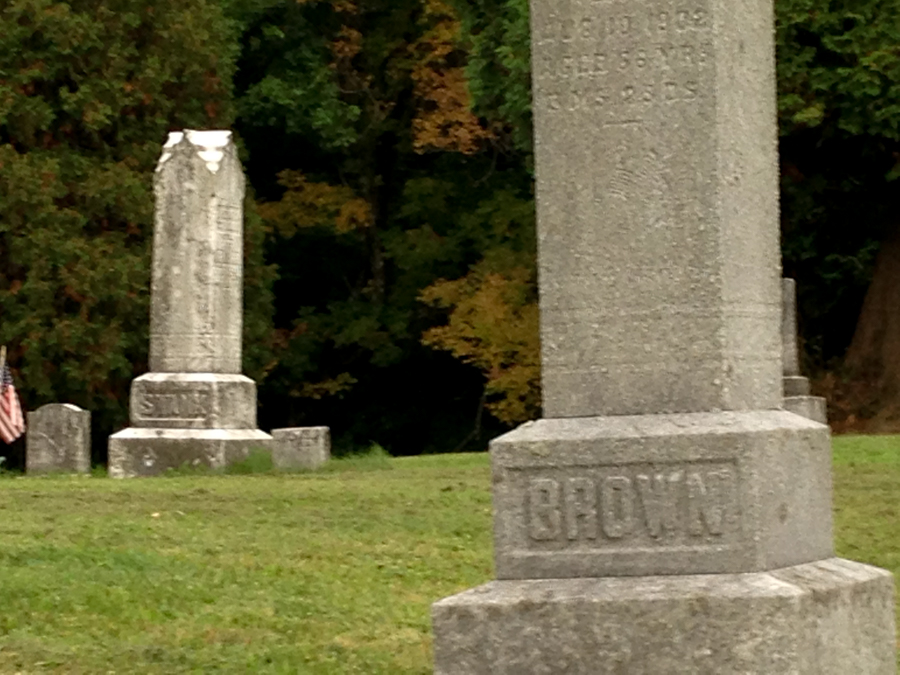
Franklin Bethel Cemetery, also known as Stone Heap, is one particular cemetery important to my family. It is a few hundred feet from the intersection of Route 42 and Route 239, situated in North Mountain Lycoming County PA, where my paternal ancestors resided for many years. I first visited Stone Heap in the summer of 1994. Although it is a smaller cemetery, I was amazed at how many names I recognized: Swisher, Swank, Rider, Reese, Brown, Allen—the names went on. It seemed as if every row contained some relative.
I have nine ancestors known to be buried in Stone Heap. One of the oldest burials in this cemetery is my 4th great-grandfather Abraham Reese. Along with his name, his stone was inscribed with his death date and age: died April 8, 1861, aged 73y 1m 18d. Unfortunately the marker was cracked and held together with a metal bar, but still clearly legible; however, when I went back a few years ago, his broken stone had fallen and showed signs of wear.


Abraham’s grandson and my 2nd great-grandfather, Josiah Reese (1832 – 1911) and his wife Effie (Shaner) Reese (1841 – 1907) are both buried there. Their children buried in Stone Heap are: Peter Milton (1858 – 1936) and wife Christie Swank (1862 – 1925); Wesley John (1861 – 1939) and wife Mary Rider (1852 – 1936) along with several of their children; James McClellan (1862 – 1931); Harvey J. (1870 – 1939) and wife Sarah Artley (1874 – 1953) as well as several of their infant children; Mary Alice (1878 – 1942) and husband James Wilson Kile (1878 – 1948) and some of their children; Charles E. (1881 – 1951); Hannah E. (1883 – 1951) and husband Henry Samuel Rider (1880 – 1951); and Sarah Jane (1867 – 1942) and her husband Charles W. Swank (1858 – 1924) who were my great-grandparents.
The other set of 2nd great-grandparents interred there are Henry Swank (1830 – 1901) and Matilda Swisher (1830 – 1902). Their children in Stone Heap include: George Clinton (1854 – 1944) and wife Christie Rachel Bay (1854 – 1925) and one of their children; Mary Hester ( 1855 – 1945), her husband G. Wheeler Christman (1851 – 1925) and some of their children; Jonas (1859 – 1931), his wife Mary Etta Temple (1863 – 1954) and their son, Oscar Raymond; Thomas Downing (1867 – 1942), his first wife Nellie Jane Reese (1872 – 1932) and several of their children, as well as his second wife Minnie Artley (1890- 1987); Caroline (1869 – 1969) and husband Jerimiah Oliver Temple (1864 – 1952); Cora Mae (1874 – 1959) and husband James Monroe Watts (1869 – 1929) along with a few of their children; the aforementioned Christie with husband Peter Reese; and the aforementioned Charles and Sarah Reese. Two daughters of Charles and Sarah are buried near them; Verna Longenberger and Eva Tobolski with her last husband Anthony Tobolski.
Another set of great-grandparents, John Brown (1835 – 1902) and his second wife Margaret McGarvey (1841 – 1923), are the final pair of my ancestors laid to rest in this graveyard. Most of Margaret’s children by a previous marriage are also in Stone Heap: Martha Jane (1863 – 1956) and her husband John Temple (1860 – 1937) along with some of their children; Susanna (1865 – 1952) and a couple of her children; Mary Clara (1868 – 1945) and husband William Walter (1852 – 1925); Minnie Idella (1870 – 1951 and her husband Jacob I. Phillps (1871 – 1948) and a few of their children.
These are a sampling of the families I have identified as relatives in Stone Heap. Every time I go to the Lycoming County area I visit the cemetery. On one of my last trips a couple years ago, I was surprised by the deterioration of some of the granite stones. The outer surface appeared eaten away, perhaps by the lichen type growth covering some of the stones. As with all cemeteries, weather will wear away the monuments and over time the inscriptions or even the tombstones will disappear.
As I walk the cemetery I sometimes wonder who might be interred there without a marker. Since the Brown homestead was in close proximity to Stone Heap, it’s likely that John’s parents were buried there. John’s first wife had died delivering twins, and a document mentions she was buried at North Mountain cemetery, which probably was Stone Heap, but no stone is found for her. John and Margaret had a daughter who died before reaching adulthood—could she be somewhere in this cemetery? If a stone had existed for these family members, it suffered a fate similar to that of Abraham Rees’ stone, which lies broken and in threat of being forgotten.
Fortunately, some are taking steps to ensure that at least the inscribed information will no longer be lost. In various places groups have read and recorded the inscriptions of the stones preserving family knowledge for future generations. The Lycoming County Genealogical Society has made an effort to read all cemeteries in its county and completed Stone Heap in the 1980s, which is available in print from the society. It includes some additional information, such as a wife’s maiden name; it is unclear if this information came from cemetery records or family members. Nonetheless, it is a great reference book.
Find a Grave, an online website, enlists a network of users who submit gravestone information for cemeteries to their site, although it is not all inclusive. Searches can be done for a particular name, cemetery, or a location, and the results include an extraction of the marker inscription. Some images of the marker have been uploaded, and occasionally an extract of an obituary of the deceased is included. On their site a photograph of Abraham Rees’ stone in Stone Heap—Memorial # 88428237—preserves his memory for generations to come. This site is an invaluable resource when searching for departed relatives enabling one to view distant cemeteries with a click from anywhere in the world.
Of all the cemeteries I have visited, I feel a special connection to Stone Heap. Standing in the cemetery and looking out over the farm land, I easily envision my ancestors working the field, traveling the road on horses, attending the church for services, and performing the difficult task of burying their loved ones. When I am at their graves, not only do I pay my solemn respect, I also celebrate their lives and accomplishments that have enabled me to stand there among them. For me they are not dead, but very much alive in my thoughts and my heart.
 Relatively Speaking Blog