When early records are scarce for a family, land records, especially deeds, can sometimes provide clues. A deed can establish residency and provide information about immediate neighbors who were sometimes relatives. When a married man sold property, his wife was named and interviewed, apart from her husband, to determine that she was in agreement with selling the land—perhaps as a way for her to protect her dowry. Family members often sold property to their children or siblings, keeping it in the family. If an owner died, a deed might list the heirs who inherited the land—quite useful if no will was made. It was my hope that deeds might help with my search of the Blackston family.
In a blog post from August 2015, I mentioned James Blackston had settled around 1819 in Westmoreland County PA as a widower with a large family. After his arrival he married Elizabeth West, daughter of Martin West. Census records show a number of children in their household, although it is not known if the children were James’ or perhaps his grandchildren. In 1840 James is thought to have died on a trip back to Delaware, leaving Elizabeth to care for the family.

In the summer of 2015, Victor and I went to the Westmoreland County courthouse. We searched the Orphan Court records; no probate was found, indicating James did not leave a will and Letters of Administration were never granted. There were also no requests for guardians to be appointed to any children who might have been under 14 at the time. With no luck there, we went to the Recorder of Deeds office and searched for James in the deed books using the old Russell Index System.
Several James Blackstons were listed. Two of the deeds were for a James Blackston, believed to be a distant cousin to my James, who lived in neighboring Fayette County. Another document recorded December 1819 in Unity Township (Deed Book 13 page 629) was not a land purchase but a bill of sale for one tame mare, one black horse and one harness to William Bell and John Hunter for $26. This appears to be my ancestor in Unity Township. Apparently my James never owned real estate during his lifetime, although he was on tax rolls for personal property.
While searching the Grantee Index for James, we found Elizabeth Blackston buying property in Youngstown PA in 1857. Her father had been a leader in this community and some family members still resided here, perhaps why she purchased here. The deed (Deed Book 14, page 143) stated Elizabeth “bought the land from Edward J. Keenan for the sum of $100”, “situated on Main Street” and “bordered lands of Patrick McAtee, A.A. Johnstown and others”. Details seemed lacking; other deeds have more explicit details of the property boundaries and adjacent owners, along with the date and location of the property’s previous deed transaction.
Since she had owned land, I went to the Grantor book to see when Elizabeth sold this property, but she was not listed. We scoured the Index for first names that began with E and last names that began with B, in the off chance her name was misspelled. But Elizabeth was not found. We approached the clerk at the courthouse to inquire how we might find when this property was sold. She told us to check the Grantor Index and when we explained it wasn’t listed, she was stumped. A researcher who overheard us suggested we find the property location today and then trace backwards. It seemed so simple and yet a little daunting with so few clues to follow.
Victor asked why I wanted to find the deed selling the land. I considered that maybe it would reveal some clues, and perhaps the sale was indexed under another name. Most unlikely, but a possibility, was that after 20 years of being a widow, Elizabeth remarried and she and her new husband sold the land. Another scenario was that Elizabeth had died while owning the land and her heirs had sold the lot, but it was listed under their names, not as Elizabeth’s estate. If this were the case, it could shed some light on the names of her and James’ children. It was this prospect that encouraged me. So we persisted in our attempt to locate the parcel and thus began our year long quest.
Our strategy consisted of examining deeds for the original owner and her neighbors, looking at census records, tax records and maps in an effort to pinpoint the location. At the courthouse we found the deeds for Edward Keenan, A.A. Johnston and Patrick McAtee covering the period of 1855-1865—a few years before she bought the plot to a few years after she is thought to have died. Edward Keenan inherited several parcels of land from his father and details of these land transfers yielded no clarity for which lot he sold Elizabeth. Elizabeth’s neighbors, Patrick McAtee and A.A. Johnson also were buying and selling property at a high rate, perhaps owning many of the lots of Youngstown. We jotted down notes for their transfers during this period and made small diagrams to identify the location of these plots, keeping an eye out for any mention of Main Street.
Last winter I located a landowner map of Youngstown from 1867, and Victor printed a GIS map of the town listing current streets and lots. Using the abstracts we diagramed, we marked locations for the sales of McAtee and Johnson. I also scrolled through the 1860 census checking who was listed in Youngstown Borough for additional clues. Many of the people on the 1867 map were in the census. However, in 1860 Elizabeth was listed in Unity Township, not Youngstown. Had she moved and was now renting her house?
This summer at the courthouse we spent time in the tax office reviewing records for Youngstown. Unfortunately, the only relevant books available were for 1857 and 1858, with Elizabeth registered paying property tax in the latter. While perusing these books we noted who was living in Youngstown during those two years to compare against the 1867 map and rule out where Elizabeth was not living. We studied the tax maps and identified several likely plots based on our analysis of the information. We wrote down the map and parcel numbers for four properties along Main Street, then went to the county’s property assessment site to find the current owners. I gave Victor the honor of selecting the first property to start our backward trace; it was parcel 79.
The clock was ticking with less than 30 minutes till the courthouse closed. We turned to technology, typed the names in the courthouse computer, selected the correct deed, and loaded it on the screen. Skimming through we found information about the previous sale, which we used to quickly pull up the next recorded deed. Then the announcement sounded that the courthouse was closing in a few minutes. As the clerk shut down the computers she informed us that we could continue our search at home through the county website.
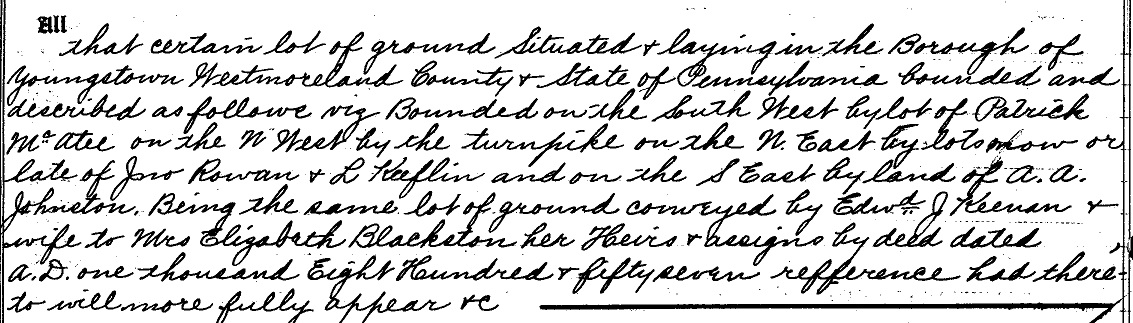
That evening Victor could hardly wait to login to the county site to investigate whether this parcel was Elizabeth’s. In the deeds simple search he entered the information from the last deed we had observed. After going back a few owners, the search feature did not appear to work, however, I realized we needed to switch to the Archive Search for deeds before 1950. A deed from 1928 had familiar names, including a mention of Patrick McAtee who had sold this lot in 1859 to the current grantor, Catherine Campbell. The next record we surveyed contained, “Being the same Lot conveyed by E.J. Keenan & wife to Mrs. Elizabeth Blackston by deed dated 20th day of Oct. 1857…conveyed by Mrs. E. Blackston to P. McAtee by deed Dated 22 Febr 1858.” Victor had picked the plot! The transfer from McAtee to Campbell occurred in 1859, but was not recorded until March 9, 1906; why it took 47 years to record is unclear. There was no reference to where the sale from Elizabeth to Patrick McAtee was logged, but advancing a few more pages I found the deed on page 247 of the same book. Elizabeth only owned the property for a few months!
Undoubtedly I had hoped this adventure would have revealed new information on James’ children, nevertheless, it was a great learning experience. My understanding of how the courthouse and website maps correlate to land records has grown. Although I have always enjoyed inspecting the large books, learning how to use the latest technology, thus gaining the ability to access the Westmoreland County website and work from the comfort of home is a great advantage. I definitely will utilize these new tools for future searches in Westmoreland County.
 Relatively Speaking Blog