Every year as Memorial Day approaches and the weather gets warmer, I start thinking about gardening and planting vegetables. For much of my adult life I’ve had some type of summer garden, planting at least tomatoes, along with some other typical vegetables, such as peppers, radishes, and eggplants. Living in the city, we are fortunate to have a modest plot of about 300 square feet in a community garden not far from home; it is sufficient to harvest fresh vegetables to eat throughout the summer and to preserve some to enjoy over the winter months. This year as I was readying our plot, I contemplated my attraction to working the land and feeling the dirt in my hands. I recognized how agriculture is a part of my history.
While turning over the soil with my shovel, my mind traveled back to the summer I worked on a nearby farm when I was fifteen, assisting Mr. Poole and his family. I helped with some of the chores such as picking corn and selling it at a roadside stand, baling hay, loading the bales in a truck from the field and then piling it in the barn, and feeding chickens and pigs—one pig gave birth to several piglets one afternoon when I was working. That work experience helped me to appreciate the challenges and rewards of farming.

My thoughts soon turned to my dad, Raymond, who had a garden, even if it was only a tiny area with a few vegetables. Once his tomato plants grew to heights reaching over 6 feet tall and formed a wall over a structure he built to support them. He usually planted tomatoes, and although none ever grew to those heights again, his tomatoes always were more delicious than those from a store. Another time he planted onions, but never harvested them; year after year they would come up each spring and grow till winter came. We often joked that they were “winter” onions, “spring” onions, etc. depending on the season. But it was when he was retired with a little country house that he was in his gardening glory. He plowed a large area for a garden—more like a micro farm—and planted rows and rows of vegetables. By August he had cultivated a bounty of produce, more than what my parents could eat or even give away. My mom spent much of that month preserving what she could and I helped her can jars and jars of tomatoes, which I used to make homemade sauce in the winter.
As I took a small break I recalled my grandfather, William Ludwick, who loved roses and grew a variety of them trellising around his small patio, giving it a sense of being enclosed. He also had a small strawberry patch in the yard. One May day when I was about four years old, he was showing my brother and me his strawberries. The green plants were in several long rows and there were some traces of red. He gave us permission to pick a strawberry to eat and I can remember how wonderful it tasted. Whenever I eat a truly delicious strawberry, it always takes me back to that day in May.
As I continued with my task of breaking up the dirt with a hoe to work in compost and raking the soil smooth of rocks, I acknowledged the numerous ancestors and relatives listed as farmers in 19th century census records. Brown, Reese, Swank, Swisher, Shaner, Ludwick, Rugh, Blackson, Fowler and Zollars are among the names on my tree who made their living by tilling the land. I imagine most had horses, mules or oxen to pull plows and help lighten the burden, and their children likely assisted with the many tasks. Their farms were essential, not just for their families, but for the entire community. Others who had different professions probably relied on some type of garden to help supplement their table and feed their family. Then there are the pioneers in this country who had to clear the wilderness by hand to create a suitable place to harvest crops, facing hardships we rarely consider.
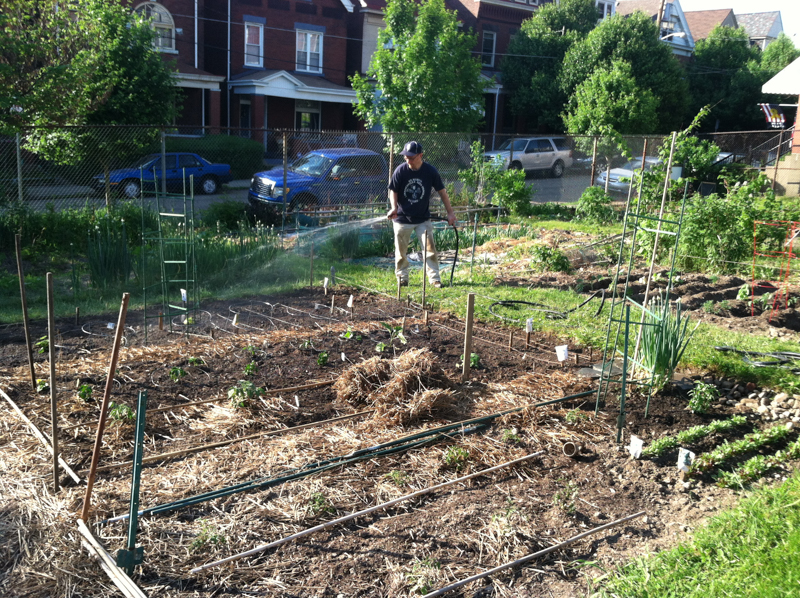
Having completed my task for our plot, the soil now prepped for planting, I surveyed my efforts. I had a connection to the earth, and also to my father, my grandfather and the line of farmers — professional and recreational — in my pedigree. I felt a sense of contentment, not only in the work that I had done, but knowing that in some small way I was carrying on a tradition that has been in my family for generations.
 Relatively Speaking Blog